

IrisGuard, the World Food Programme, and the UN Refugee Agency:
A Case Study in Technocolonialism
By Jordan Liz
Volume 27, no. 2, Political Economy of Science
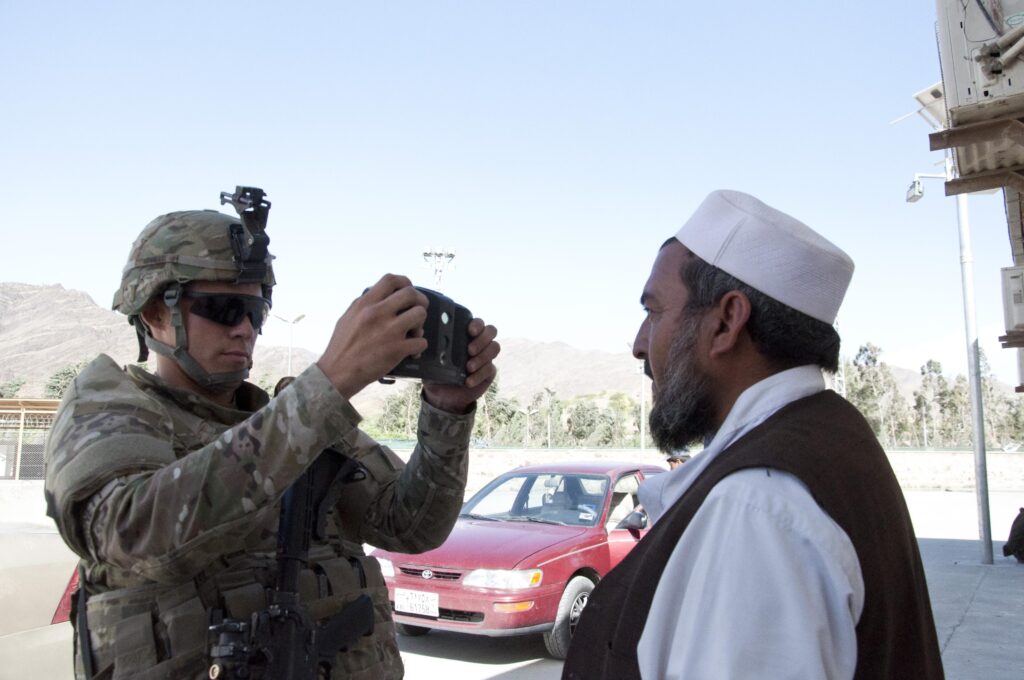
Humanitarian organizations are increasingly incorporating biometric systems into their day-to-day operations. In 2002, the United Nations High Commissioner for Refugees (UNHCR) introduced iris scans as part of the repatriation process of Afghan refugees in Pakistan. Their stated goal was to prevent “recyclers:” individuals who allegedly received aid, returned to their home country, and then immediately left to reregister and receive more aid.1 The International Committee of the Red Cross (ICRC) leverages artificial intelligence and facial recognition to help reconnect families who have lost contact or been separated on migration routes.2 These organizations claim that biometric technologies are instrumental in making the services they offer more efficient and effective. At the same time, mass data collection is used to demonstrate effectiveness and accountability to the private donors and countries that fund and support their work.
This trend is characteristic of what scholar Mirca Madianou refers to as “technocolonialism.” In her view, technocolonialism reflects the convergence of digital data systems with humanitarian structures, state powers, and market forces to recreate colonial relationships of dependency. This convergence is driven by five intersecting logics: first, “the logic of humanitarian accountability,” the belief that advanced technologies promote transparency and responsibility. Second, “the logic of audit” that sees digital technologies as necessary to demonstrate the effectiveness of humanitarian work to donors. Third, “the logic of capitalism” by which companies reconceptualize humanitarian work as a profit-generating enterprise. The fourth, “the logic of solutionism,” is the belief that advanced technologies are needed to solve complex social problems. Finally, fifth, “the logic of securitization” that conceives of refugees as a security risk that must be carefully surveilled.3
The partnership between the UNHCR, the UN World Food Programme (WFP), and the biometric firm IrisGuard, exemplifies technocolonialism. I argue IrisGuard’s technological innovation is being fueled by the exploitation of refugees and forcibly displaced people for the sake of profits and private interest. I further argue that organizations like UNHCR and WFP must be replaced with new institutions that prioritize the wellbeing of vulnerable communities.
The Case of IrisGuard, WFP, and UNHCR
In 2016, the WFP introduced a first of its kind payment system that would allow Syrian refugees in Jordan to purchase food and other goods via an iris scan. The scan triggers a two-step process: first, the system cross-references a person’s iris scan with the UNHCR’s biometric registration database to confirm their identity as an eligible refugee. Second, it checks their account balance with the financial services firms. If they have enough funds, it confirms the purchase and prints out a receipt. The WFP touts that the entire process is fast, efficient, secure, and avoids transaction and other fees related to conventional money transfer services.4
This iris scan payment system was developed by the biotech company IrisGuard. Founded in 2001, IrisGuard describes itself as the only global company that completes end-to-end secure financial transactions using only the human iris. In addition to working with the WFP, IrisGuard has also partnered with several other humanitarian groups. They have developed software UNHCR uses as part of their biometric registration, and their financial services platform is utilized by United Nations Children’s Fund, Catholic Relief Services, and Save the Children, among others. In total, IrisGuard reports that it handles an estimated $1.2 billion US dollars a year in humanitarian cash, or almost 10% of all distributed humanitarian aid.5 These partnerships have allowed IrisGuard to establish itself as a leader in iris recognition biometrics whose patents for several iris-based technologies, such as EyePay, EyeCloud, EyeCash, and EyeHood, have attracted multimillion dollars investors like Growthgate and Goldman Sachs.6 IrisGuard has also benefited from direct payments from humanitarian groups. Between 2014 and 2018, UNHCR awarded IrisGuard nine contracts for computer services and registration equipment worth $3.3 million US dollars.7
Such growth would not have been possible without exploiting displaced people. While the UNHCR and WFP stress the importance of biometrics, such technologies remain widely controversial and highly regulated worldwide. In the EU, for instance, the General Data Protection Regulation (GDPR) sets stringent guidelines for lawful acquisition, processing, and use of biometric data. This includes high standards for informed consent and prohibitions against distributing data to third parties.8 While the UNHCR’s General Policy on Personal Data and Privacy (GDPP) includes similar guidelines, the agency consistently ignores them.9
Registrants are seldom informed of their rights. As one refugee subjected to this system bluntly put it, “As a refugee, we do not have much say. You do as you are told.”10 This power asymmetry is at the core of technocolonialism. In the blink of an eye, IrisGuard and other biometrics companies gain access to hundreds of thousands of unknowing, non-consenting, and unpaid market testers on whom to trial the viability of their products and services. Imada Malhas, CEO and Founder of IrisGuard, effectively makes this point. According to a 2019 report by the International Finance Corporation (IFC), Malhas notes that IrisGuard’s work with refugees is “not profitable,” but “sees significant nonmonetary value to IrisGuard serving refugees—through the opportunity to improve refugees’ lives, while demonstrating the quality of its technology’s various applications.”11 This demonstration, or undisclosed investment in research and development that bypasses safety protocols, is a calculated business decision aimed precisely at maximizing profit. By capitalizing on the lack of consistent oversight of UNHCR and WFP, corporations like IrisGuard can expose refugees to the most invasive and risky technologies.12
This vulnerability is amplified by the coercive tactics used by these organizations to compel consent. WFP, for instance, explicitly emphasizes that “a beneficiaries’ refusal to provide the required information may make it impossible for WFP to provide assistance.”13 This is a real threat. In June 2019, the WFP temporarily suspended food aid distribution in Yemen after the Houthi government opposed biometric registration, arguing that it threatened Yemen’s national security and that UN control of the data was against Yemeni law.14 This worry was not unfounded. During the 2017 Rohingya Refugee Crisis, the UNHCR improperly collected and shared personal information (including fingerprints, facial images, and other biometric data) of refugees with the government of Bangladesh, which then shared it with the government of Myanmar (the country those refugees were fleeing from). Human Rights Watch (HRW) reports that all this was done without the consent of the refugees and in violation of the UNHCR’s own policies concerning protecting personal data.15
Both the UNHCR and WFP routinely emphasize that biometrics are needed to prevent fraud. The UNHCR, for instance, claims that biometric registration reduces the likelihood of “identity substitution” (such as replacing an unrelated person with a missing family member), “fraudulent family composition” (failing to disclose a family member, misrepresenting minors as own biological children, and so on), “multiple registrations” (the “recyclers” described earlier), and identity theft. However, a 2016 audit of UNHCR’s Biometric Identity Management System (BIMS) by the Office of Internal Oversight Services (OIOS) was unable to assess whether BIMS was providing any of these benefits. Part of the problem was the failure of UNHCR to provide clear criteria, indicators, or metrics for how to assess these benefits in the first place.16
The lack of transparency on this issue has been well documented by several reports on the use of biometrics by UNHCR and WFP.17A study examining the alleged “recycler” problem found that of 500,000 refugees registered with UNHCR in Ethiopia, fewer than 500 were registered twice.18 Importantly, while this study did find duplicate registrations, this finding does not confirm UNHCR’s claims about “recyclers.” Duplicate registrations may be due to human or algorithmic error. Consider, for example, WFP’s SCOPE platform, which stores every beneficiary’s personal and biometric information. Each new profile is automatically processed by the MegaMatcher Automated Biometric Identification System (ABIS), which calculates the likelihood that it is a duplicate. If the algorithm is unable to generate a conclusive result, then a human makes the decision.19 While WFP claims SCOPE increases accountability for beneficiaries and donors, in practice, it and similar systems make the registration process far less transparent.20
During the launch of the iris scan payment system in 2016, Mageed Yahia, the WFP Country Director in Jordan, remarked that “Iris scan technology has reshaped the shopping experience for Syrian refugees in Jordan, making it easier and more secure for them, while also enhancing accountability.”21 Despite this self-acclaim, one small-scale study conducted in Jordan found that roughly two-thirds of refugees preferred cash assistance on an ATM card rather than the iris scan. Respondents generally preferred the flexibility of being able to have someone else access goods on their behalf. As one respondent noted, “The card is easier to be honest. For example, my husband is ill and can’t go and get it, but with biometrics [I can’t]; sometimes he’s too tired because he had a heart surgery, so he’s always sick.”22 While some UNHCR programs allow multiple family members to have biometric access to aid, this is not the case in Jordan. Under the Common Cash Facility (CCF) program, each beneficiary household must designate a single “cash collector” as the monthly recipient within IrisGuard’s EyeCloud platform. But this is not effectively communicated with refugees.23 It is a failure that makes navigating a complex aid system even more challenging. Instead of simplifying the process, the UNHCR has managed to create more hurdles in the name of reducing an unquantified and unsubstantiated form of fraud.
The study in Jordan also found that refugees experienced problems using biometric scanners, especially among the elderly and those with health problems. As one refugee explained,
“I see that most elderlies, anyone between 50 to 60 years old, needs half an hour to an hour until it recognises their iris. My mother is one of those people. The problem is in the iris not in the machine. When my mother got winter assistance, she had to use an eye drop in order for the machine to recognise it.”24
Another respondent reported,
“I started having issues in my eyes three months ago. This makes me repeat my eye scans multiple times until it works, and the money is dispensed. Sometimes I stand in line four or five times until it works. One time I had to come back the day after to relieve my eye overnight. I ask someone to come with me to focus my eyes at the camera. For three months now, I couldn’t focus on my own, no matter how I tried, and they start watering.”25
These problems are likely exacerbated by the many barriers facing asylum seekers and refugees attempting to access healthcare in host countries.26
To be clear, the problem here is not simply that corporations or aid groups benefit. Rather, it is how financial incentives have shifted the focus of humanitarianism from an ethos of care to coercion and surveillance. This sentiment is captured in Imada Malhas’s defense of UNHCR’s use of iris-scanning biometrics: “When refugees flee war, they become citizens of a country called UNHCR until they return to their country or are resettled. Does this country UNHCR not have the right to own the data of its citizens?”27 Malhas’s description of UNHCR is inherently at odds with its designation as an international organization with a legal mandate to provide protection and aid to refugees and other displaced populations. In other words, Malhas, the CEO of a major UNHCR business partner, fundamentally misunderstands (or intentionally misrepresents) what the UNHCR is supposed to be. Based on his words, Malhas appears to legitimize forced biometric registration by depicting UNHCR as an unelected government and refugees as citizens who are obligated to submit. When Malhas justifies biometric registration in the terms of the “right to own the data of its citizens,” he is no longer talking about an effort to enhance humanitarian initiatives, but rather endorsing an absolute exercise of sovereign power.28
This is unacceptable. While advanced technologies and scientific innovations can contribute to genuine humanitarian goals, they cannot do that when guided by the logics of technocolonialism. UNHCR and WFP are more preoccupied with appeasing donors and serving tech companies than prioritizing the needs of refugees. In 2016, OIOS found that the UNHCR-appointed Information and Computer Technology Governance Board failed to adequately document their rationale for recommending the purchase of a multi-modal biometrics system that utilized both iris and fingerprint scans. This, despite the fact that the system would be an estimated $600,000 US dollars more expensive than a single-modal system.29 Meanwhile, as one refugee put it, “Unlike what the UNHCR staff is saying, the new digital registration system didn’t initiate any new special benefits package. We are getting the same usual assistance like food rations and other non-food items we used to get. … I doubt if the new system would at all bring any extra aid benefits.”30
At its core, the basic problem is that humanitarianism and capitalism are fundamentally incompatible. The current entanglement between the UNHCR, WFP, and IrisGuard, I believe, demonstrates this. What we need is a new global network of humanitarian groups that prioritize the wellbeing and flourishing of refugees and displaced people. Under the current system, the financial incentive is not to serve refugees but to maintain them as a permanent reserve army of biotech product testers. Refugees have been reduced to biodata factories that demonstrate the viability of increasing invasive biometric surveillance technologies. Their vulnerability has been absorbed within capitalism. This has implications that go far beyond the humanitarian sector. IrisGuard alone has ties to telecommunications, healthcare, banking, social services, law enforcement, and border control, among other fields.31 The artificial intelligence and surveillance juggernaut Palantir, another WFP partner, has very close ties to the US military and Department of Homeland Security.32 That these companies have ties to the police and military-industrial complex is unsurprising given the growing strategic value those institutions place on biometrics and “identity dominance.”33 These entanglements mean, however, that technologies being field tested on refugees may be used in armed conflicts that cause more displacement. Rather than solving a problem, they are actively contributing to it.
UNHCR was never meant to be an international relief agency. As historians Jérôme B. Elie and Jussi Hanhimäki note, “at its creation, UNHCR was a rather weak organization, with a clear Western and European focus and a limited mandate.”34 During the 1960s, UNHCR grew to become a global organization. This occurred in large part because of the willingness of the agency’s officials to extend their mandate to all peoples and countries.35 But this willingness no longer seems to exist. The mandate the UNHCR serves now is technocolonial. Building alternatives to UNHCR will be daunting, but not impossible. Already groups such as the International Refugee Assistance Project provide a model for meaningful advocacy that both aids refugees while critiquing the forces of “colonialism, military conflict, and environmental degradation, that have directly caused displacement.”36 UNHCR, WFP, and IrisGuard are failing refugees. Now it is up to those of us who can—whether individuals, institutions, or governments—to support and build humanitarian groups that work for refugees and not just themselves.
—
Jordan Liz is an Associate Professor of Philosophy at San José State University. He specializes in issues regarding race, immigration and the politics of belonging. His current research examines, first, how biometric technologies in the context of immigration enforcement function to redefine who and under what conditions one is recognized as a citizen. Second and relatedly, how those technologies expand the boundaries of the police state and who is exposed to state violence.
The Political Economy of Science issue is also available in print. Subscribe/purchase this issue to read it today.
Notes
- “Afghanistan: Iris-Testing Proves Successful,” UN Refugee Agency (UNHCR) Brief Notes, October 10, 2003.
- International Committee of the Red Cross (ICRC), “Rewards and Risks in Humanitarian AI: An Example,” Inspired, September 6, 2019.
- Mirca Madianou, “Technocolonialism: Digital Innovation and Data Practices in the Humanitarian Response to Refugee Crises,” Social Media + Society 5, no. 3 (2019): 1-13, https://doi.org/10.1177/205630511986314.
- United Nations (UN), “Iris Scan Helps Syrian Refugees in Jordan Receive UN Supplies in ‘Blink of Eye,’” UN News, October 6, 2016; Russ Juskalian, “Inside the Jordan Refugee Camp that Runs on Blockchain,” MIT technology Review, April 12, 2018.
- “Why IrisGuard,” IrisGuard, accessed September 2, 2025.
- Martin Lemberg-Pedersen and Eman Haioty, “Re-Assembling the Surveillance Refugee Body in the Era of Data-Craving,” Citizenship Studies 24, no. 5 (July 5, 2020): 607-624, https://doi.org/10.1080/13621025.2020.1784641; “Investor Information,” IrisGuard, accessed September 10, 2025; “EyeHood® – Portable Biometric Enrolment Camera,” IrisGuard, accessed September 16, 2025.
- Lemberg-Pedersen and Haioty, “Re-Assembling the Surveillance Refugee Body in the Era of Data-Craving.”
- “General Data Protection Regulation,” Intersoft Consulting, accessed September 5, 2025.
- “Audit of the Biometric Identity Management System at the Office of the United Nations High Commissioner for Refugees,” Office of Internal Oversight Services, December 22, 2016.
- “Understanding the Lived Effects of Digital ID: A Multi-Country Study,” The Engine Room, January 2020.
- “Private Sector & Refugees: Pathways to Scale,” International Finance Corporation, April 2019.
- Kristin Bergtora Sandvik, Katja Lindskov Jacobsen, and Sean Martin McDonald, “Do No Harm: A Taxonomy of the Challenges of Humanitarian Experimentation,” International Review of the Red Cross 99, no. 1, 2017, https://doi.org/10.1017/S181638311700042X.
- “WFP Guide to Personal Data Protection and Privacy,” World Food Programme, June 2016.
- Ben Parker and Annie Slemrod, “UN Gives Ultimatum to Yemen Rebels Over Reports of Aid Theft,” The New Humanitarian, June 17, 2019; Teresa Welsh, “Biometrics Disagreement Leads to Food Aid Suspension in Yemen,” Devex, June 24, 2019.
- “UN Shared Rohingya Data Without Informed Consent,” Human Rights Watch (HRW), June 15, 2022.
- “Audit of the Biometric Identity Management System.”
- “Biometrics in the Humanitarian Sector,” The Engine Room, March 2018; Kerrie Holloway, Reem Al Masri, and Afnan Abu Yahia, “Digital Identity, Biometrics and Inclusion in Humanitarian Responses to Refugee Crisis,” Humanitarian Policy Group (HPG) Working Papers, October 2021; Dragana Kaurin, “Data Protection and Digital Agency for Refugees,” World Refugee Council Research Paper No. 12, May 2019.
- Holloway, Al Masri, and Abu Yahia, “Digital Identity”.
- “Biometric Deduplication,” World Food Programme.
- “WFP SCOPE,” World Food Programme, September 2019.
- “WFP Introduces Iris Scan Technology to Provide Food Assistance To Syrian Refugees in Zaatari,” World Food Programmme.
- Holloway, Al Masri, and Yahia, “Digital Identity.”
- Heidi Gilbert and Lois Austin, “Review of the Common Cash Facility Approach in Jordan,” The UN Refugee Agency (UNHCR).
- Holloway, Al Masri, and Yahia, “Digital Identity.”
- Holloway, Al Masri, and Yahia, “Digital Identity.”
- Ashrafunnesa Khanom et al., “Asylum Seekers’ and Refugees’ Experiences of Accessing Health Care: A Qualitative Study,” BJGP Open 5, no. 6 (October 13, 2021): 1-11.
- Mirjam Twigt, “Doing Refugee Right(s) with Technologies? Humanitarian Crises and the Multiplication of ‘Exceptional’ Legal States,” Refugee Survey Quarterly 43, no. 1 (October 31, 2023): 1-21, https://doi.org/10.1093/rsq/hdad020.
- Twigt, “Doing Refugee Right(s) with Technologies?”
- “Audit of the Biometric Identity Management System.”
- “Refugees in Ethiopia’s Camps Raise Privacy and Exclusion Concerns Over UNHCR’s New Digital Registration,” Advox Global Voices, 19 March 2020.
- “Business Sectors We Serve,” IrisGuard, https://www.irisguard.com/business-sectors/.
- “Palantir for the US Army,” Palantir; “Palantir and WFP Partner to Help Transform Global Humanitarian Delivery,” World Food Programme, February 5, 2019.
- Eugene J. Porter, “Biometrics: A Case Study into How Commanders Can Influence Biometrics in a Counterinsurgency Environment,” 2019.
- Jérôme B. Elie and Jussi Hanhimäki, “UNHCR and Decolonization in Africa: Expansion and Emancipation, 1950s to 1970s,” Archiv für Sozialgeschichte 48 (2008): 53-72.
- Elie and Hanhimäki, “UNHCR and Decolonization in Africa: Expansion and Emancipation, 1950s to 1970s.”
- “Mission & Vision,” International Refugee Assistance Project (IRAP), accessed September 16, 2025.