
The Scientific Factory Floor
How Capitalism Alienates Researchers
By Renu Kumari
Volume 27, no. 2, Political Economy of Science
The worker therefore only feels himself outside his work, and in his work feels outside himself. He feels at home when he is not working, and when he is working he does not feel at home. His labor is therefore not voluntary, but coerced; it is forced labor.
—Karl Marx, Economic and Philosophic Manuscripts of 18441
What does it mean to be alienated? At its core, it is a process of separation and loss. Karl Marx argued that under capitalism, workers are systematically disconnected from the value and meaning of their work. Alienation is not a mere feeling of dissatisfaction, but rather a structural feature where one must sell their labor to survive. Because we do not own the tools, spaces, or products of our work, our creative activity becomes a commodity—a thing we sell to another. The relationship is dialectical: alienated labor produces private property, and private property in turn reinforces alienated labor. This transforms labor into a means to an end (a paycheck and, more so, the profit a company makes from our work), inherently generating a sense of estrangement. The worker loses reality, becoming a servant to the very objects they create but do not own.
But what does alienation mean for a scientist? For the 19th-century textile worker, it was straightforward: the cloth they wove was taken from them and sold for a profit they never shared. For the scientist, the product is more abstract but no less real: it is knowledge itself. This can take the form of a published paper, a patented technology, a novel dataset, or a validated theory. The specific output varies by field (e.g., a philosopher’s treatise on ethics and a biochemist’s new assay are both knowledge products), but all are creations of intellectual labor. Alienation occurs when the scientist is stripped of ownership and agency over this knowledge, when its purpose is dictated not by curiosity but by the market. That creeping sense of dissonance—when the work that was supposed to fulfill you instead drains you—isn’t a personal failure. It’s the logical endpoint of a system that has turned knowledge production into an industry. Science has perfected the process of alienation.
The Modern Laboratory as a Factory Floor
Karl Marx argued that under capitalism, workers become alienated in four key ways:2
- From their labor
- From the product of their labor
- From others
- From their human potential
Walk into any research university today, and you’ll find scientists trapped in the same contradictions Marx identified:
- We are alienated from our labor. The defining question of contemporary science has become not “What is true?” but “What will sell?” The average principal investigator spends nearly half their time writing grants rather than doing research.3 Graduate students routinely abandon promising lines of inquiry deemed “good for science but not for the grant.” Consider the evolutionary biologist forced to frame their work as “biomedically relevant” to satisfy NIH priorities, or the materials chemist redirected from fundamental questions to battery research after their department partners with Tesla. The labor is coerced by the relentless demand for funding.
- We are alienated from the products of our labor. The standard academic pipeline runs straight from publicly funded labs to corporate profit centers. Taxpayers foot the bill for basic research; universities patent the resulting discoveries; and corporations then charge exorbitant prices for the resulting medicines and technologies. The postdoc who spends years perfecting a gene-editing technique might see their name buried in a patent’s acknowledgments while the university licenses it for millions. We build the code, the drug, the dataset, but we have no control over who owns it or how it is used. Once a collective human good, our knowledge becomes a private commodity.
- We are alienated from each other. The “publish or perish” mentality has turned colleagues into competitors. Information is hoarded, data is guarded, and a colleague’s success can feel like a personal threat. Postdocs compete with lab mates for lead authorship, and faculty guard their research to prevent being scooped. This system actively erodes the communal, collaborative spirit essential for scientific inquiry, leaving researchers isolated and cynical.
- We are alienated from our human potential. The average PhD student enters graduate school brimming with a passion for discovery, only to find their prime creative years consumed by menial tasks: formatting reference lists, massaging p-values, and endlessly revising grant proposals. A 2022 study surveying Australian early-career researchers (ECRs) found that 76.7 percent cited inadequate job security, lack of funding, or lack of independent positions as their primary reasons for intending to leave academia.4 The human potential for creativity and intellectual exploration is shackled by the machinery of the academic-industrial complex.
Organizing for a Liberated Science
Confronting this deep-seated alienation requires moving from diagnosis to treatment. This begins with a threefold solution, and crucially, we are not starting from zero. A wave of organizing is already building the power to make this vision a reality.
First, we must reject the myth of a “depoliticized” science. Prioritizing research for its profitability or military application, while starving public health and climate science, is a political act. Scientists are now organizing to articulate a political vision for science that serves the people, not capital. This is evident in the shift from isolated grievances to mass collective action. The 2022 University of California academic worker strike, the largest in higher education history, saw 48,000 academic workers across nine campuses halt the operations of the world’s premier public research system.5 Their demands were not just economic; they were a political statement against the poverty wages and precarious conditions that make meaningful scientific labor impossible. By winning substantial pay increases, expanded protections for international scholars, and better childcare subsidies, they fought for the material conditions necessary to do science for the public good.6 Unions are also engaging directly in the political process to protect our right to organize. Anticipating hostile federal rulings, the graduate workers union at Brown University organized with the Rhode Island AFL-CIO to pass legislation protecting student workers’ right to unionize, proving that defending science requires engaged political struggle.7
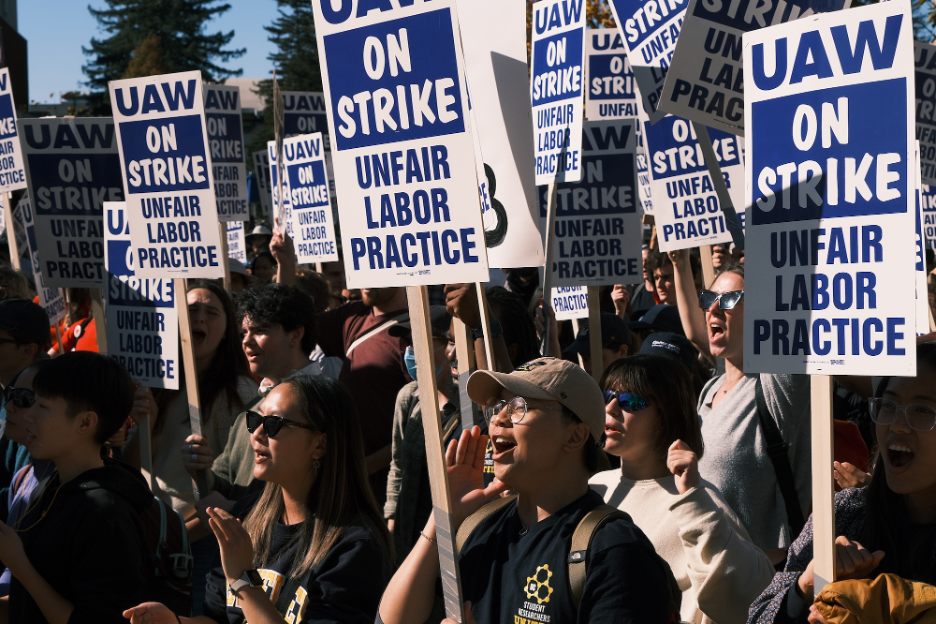
Figure 1. Academic workers on strike at UC Berkeley. Photo: Ian Castro.
Second, we must build power to counter the academic-industrial complex. A complete divorce from corporate and military funding may be a long-term goal, but the immediate work is to build systems of transparency and worker control that can reorient priorities from within. This means fighting for models that prioritize collaboration over patent-driven competition and create counter-institutions that answer to the public, not shareholders. The fight for this transparency is already being waged at the bargaining table. At George Washington University, the graduate student union won a landmark agreement for open bargaining sessions, allowing all members to observe negotiations via Zoom.8 This model directly challenges the opaque, top-down administration that forges partnerships without researcher input. Similarly, the United Campus Workers (UCW) unions practice “wall-to-wall” organizing, bringing together faculty, graduate students, staff, and undergraduates into a single union.9 This solidarity across academic workers is the essential foundation of power needed to push for ethical oversight of funding sources, champion open-source research and public ownership of breakthroughs, and demand that our institutions prioritize grants for public goods like climate science and public health over those that solely serve private profit or military ends. The goal is building collective power to negotiate from a position of strength, ensuring that all research—including that which may be funded by industry or the military—is subject to oversight, and that its benefits flow to the public.
Third, and most importantly, we must organize. The recent and explosive wave of unionization drives demonstrates that the scientific workforce is recognizing its collective power. The strategic advantage of scientific labor—its inherently collaborative and interdependent nature—is being weaponized against the system that alienates it. At the University of Pennsylvania, postdocs and research associates voted 703 to 38 (95 percent in favor) to form their union, RAPUP-UAW.10 At Northwestern University, the vote was 515 to 13 in favor of unionization.11 These overwhelming mandates are a direct response to the precarious one-year contracts and lack of job security that prevent long-term, high-risk, and meaningful research. These unions are fighting for protections specifically for vulnerable international scholars and for benefits that reflect their skill level, like graduate worker contract wins for vision, dental, and transportation stipends at the University of Chicago.12 The movement is also expanding its base. At Brown University, the formation of three undergraduate worker bargaining units created a broader foundation of solidarity, uniting the entire campus workforce.13 And when legal pathways are blocked, organizers adapt. At Berea College, workers withdrew their NLRB petition to instead build power through collective action, proving that the movement is resilient and does not rely solely on formal recognition.14
Learning From Our Predecessors
The call for a science that serves the people is not new. In the late 1960s, the Black Panther Party (BPP) established over a dozen People’s Free Medical Clinics across the United States.15 These clinics were a cornerstone of the BPP’s ‘survival programs,’ which provided free breakfast, clothing, and healthcare. Staffed by volunteer doctors, nurses, and community members, they operated on the principle that the right to health was inseparable from social justice and human dignity. It stands as a powerful historical example of building counter-institutions that answer to the public.
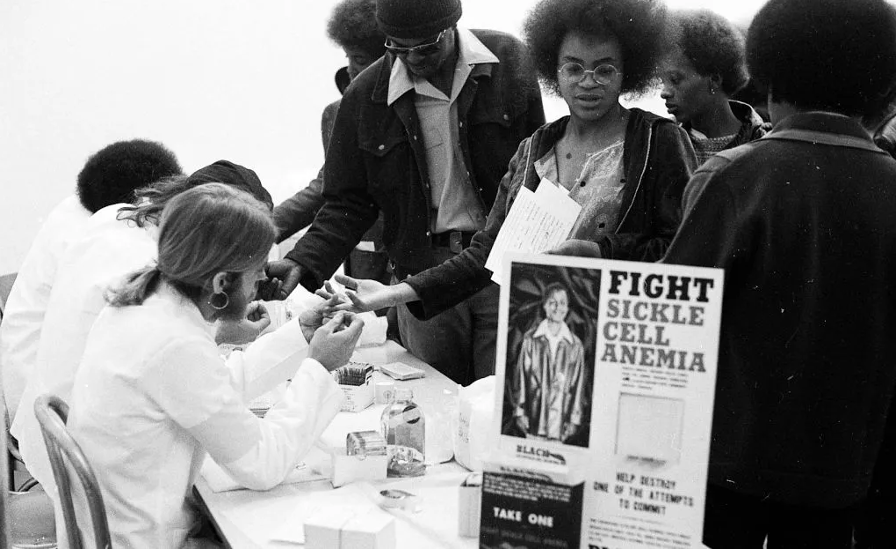
Figure 2. The Black Community Survival Conference put on by the Black Panther Party with free sickle cell anemia tests.
On an international scale, Cuba’s medical internationalism program offers a profound, if contradictory, alternative to the Western model. Since the 1960s, Cuba has prioritized healthcare and science as pillars of its national project, creating a surplus of doctors and developing its own biotech industry despite a crippling embargo.16 This has allowed it to deploy tens of thousands of health professionals to over 160 countries, often to serve the world’s most marginalized populations in the wake of disasters like the Haiti earthquake and the West African Ebola outbreak.17 These missions have had demonstrable positive impacts. During the COVID-19 pandemic, when vaccine nationalism gripped the Global North, Cuba developed its own effective vaccines (Abdala and Soberana) and shared them globally, a stark contrast to the profit-hoarding of Pfizer and Moderna.18
Lastly, the barefoot doctors were a transformative force in rural Chinese healthcare during the Cultural Revolution (1966–1976), providing basic medical services to millions of peasants and shaping global approaches to primary health care.19 By recruiting and training local villagers to provide essential healthcare and preventive services, the program broke down barriers between professional expertise and everyday life, making scientific medical care accessible to millions who had previously been neglected by the formal health system. This approach improved public health outcomes while embodying the principle that science and medicine should be tools for social equity and collective well-being, directly inspiring global movements for primary health care and influencing the World Health Organization’s call for “health for all.”20
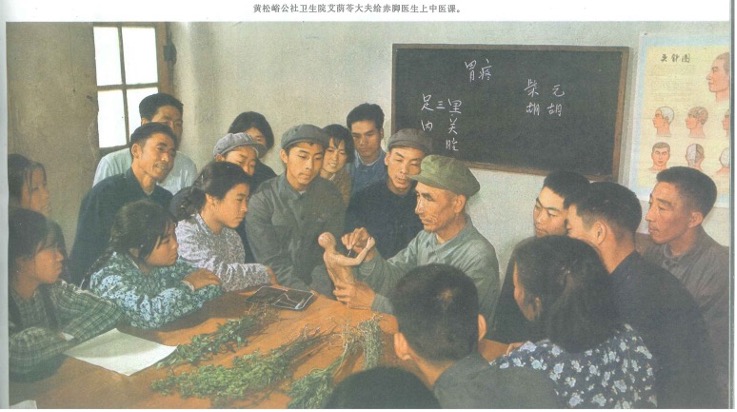
Figure 3. Doctor Ai Yinling of Huang Song Yu Commune’s clinics was giving a TCM lecture to barefoot doctors.
Final Thoughts
But this leads to the essential, final question: control by researchers is a necessary step, but is it sufficient for a science truly “for the people”? The answer is no. The goal cannot be a closed shop that merely manages its own exploitation. A liberated science must be built in partnership with the communities it purportedly serves. This means including farmworkers in agricultural research, patients in medical trial design, and indigenous communities in environmental and archaeological work. It means acknowledging that the ”scientific worker” is not the only one whose labor and land are enrolled in the project of science. Our organizing must look outward and redefine for whom and to what end science is done.
—
Renu Kumari is a student studying medicine at an American institution.
The Political Economy of Science issue is also available in print. Subscribe/purchase this issue to read it today.
Notes
- Karl Marx, Economic and Philosophic Manuscripts of 1844, (Progress Publishers: Moscow, 1959), 379.
- Marx, Economic and Philosophic Manuscripts.
- Ken Budd, “NIH Funds More Long-Term Grants,” AAMCNews, June 26, 2018.
- Katherine Christian, Jo-ann Larkins, and Michael R. Doran, “The Australian Academic STEMM Workplace Post-COVID: a Picture of Disarray, bioRxiv (2022).
- Andrea Widener, “University of California Strike Impacts Chemists,” Chemical & Engineering News, American Chemical Society, September 23, 2025.
- Casey Coffee, et al., “Editorial Office Workers’ Statement Regarding the UC System-Wide Strike,” Camera Obscura 38, no. 3 (December 2023): 1–5.
- Lucy Tobier, “Under Trump, Student Labor Organizers Face New Challenges,”The Nation, August 6, 2025.
- Dylan Ebs, “GW Agrees to Open Bargaining with Graduate Student Union as Contract Negotiations Progress,” The GW Hatchet, August 18, 2025.
- “20th Century Reflection,” United Campus Workers of Tennessee, accessed October 28, 2025.
- “Penn Postdocs and Research Associates Win Their Union,” United Automobile, Aerospace and Agricultural Implement Workers of America, last modified July 18, 2025.
- “Postdoctoral Unionization,” Northwestern, accessed October 28, 2025.
- “Graduate Student Unionization,” The University of Chicago Office of the Provost, accessed October 28th, 2025.
- “Under Trump, Student Labor Organizers Face New Challenges,” UCW Kentucky, last modified August 18, 2025.
- “Berea College Students Withdraw Union Petition,” Berea College, last modified January 24, 2025.
- Diane Pien, “Black Panther Party’s Free Medical Clinics (1969-1975),” Black Past.
- Paul K. Drain and Michele Barry, “Fifty Years of U.S. Embargo: Cuba’s Health Outcomes and Lessons,” Science 328, no. 5978 (April 30, 2010): 572–573.
- Angel A. Escobedo, et al, “Cuba: Solidarity, Ebola and Covid-19,” BMJ Paediatrics Open, 5, no. 1 (May 19, 2021).
- Hannah Todd, “Medical Diplomacy—Lessons From Cuba,” Think Global Health, June 15, 2020.
- Miriam Gross,“Between Party, People, and Profession: The Many Faces of the ‘Doctor’ During the Cultural Revolution,” Medical History 6, no. 32 (June 11,2018): 333–359.
- Cui, Weiyuan, “China’s Village Doctors Take Great Strides,” Bulletin of the World Health Organization 86, no. 12 (December 2008): 914-15, https://pmc.ncbi.nlm.nih.gov/articles/PMC2649581/.