

Evidence as a Weapon of Empire:
Lessons from the US-Mexico Corn War
By Fime de la Fuente and Megan Gross
Volume 27, no. 2, Political Economy of Science
When people think of Mexico, they might think of tacos, quesadillas, tamales, chilaquiles, sopes, elotes, itacates, mariachi, tequila, and mezcal—and even if the last three delicacies are not made of maize, the people who make them are.1 Maize, or maíz, comes from a Taino word meaning “life-giving seed,” and refers to the edible plant native to Mexico that is the lifeblood of the territory’s communities, cultures, and ecologies. Corn, on the other hand—the often-genetically-modified grain produced at monstrous scales in the United States to fuel the beef industry and capital returns of so-called free trade—comes from an Old English word meaning “small grain.”2 Since the passage of free trade agreements such as the North American Free Trade Agreement (NAFTA) and the United States Mexico Canada Agreement (USMCA), Mexico’s relationship to maize has been mediated by its economic relationship with US corn. Neoliberal policies have permitted the US to flood the market with cheap, genetically modified (GM) corn, leading to over US $6 billion in losses for Mexican growers, devastating both rural livelihoods and native maize biodiversity through displacement and gene flow.3
The inequities in transnational trade have ignited what law professor Ernesto Hernandez-Lopez aptly calls the “Corn War.” In a defensive effort to reclaim the autonomy of maize, Mexico decreed a ban on GM corn, only to be challenged and ultimately defeated by the US in a 2024 USMCA trade panel ruling. While Mexico submitted over 200 pages of peer-reviewed scientific evidence to the panel documenting environmental, health, and cultural risks of GM corn and its companion herbicide glyphosate, the trade arbitrators dismissed the evidence of harm to “biocultural wealth and peasant communities” in the dossier as unscientific.4
The question of what is “scientific” and what constitutes “evidence” is the newest battleground in the ongoing Corn War. In the case of maize vs. GM corn we ask: what fell short in the USMCA decision, the evidence, or the terrain on which the evidence was debated? Moreover, we reflect on this controversy not as an isolated case of an international trade dispute, but as a systemic example of how knowledge is legitimized or discarded in the interest of capital and state control. For example, international agrifood trade decisions determined by published research can dramatically shape the ecological dimensions of agricultural systems. However, despite overwhelming evidence that agricultural intensification does not improve food access nor conserve biodiversity, the predominance of unequal free trade agreements consistently incentivizes industrialization by encouraging crop specialization, mass production, and patented biotechnology for profit rather than life.5 As political ecologists of agriculture, we, the authors, embrace agroecology as an alternative to industrial agriculture that can strategically, generatively, and counterhegemonically reconceptualize the socioecological world for life-affirming change.
Drawing on lessons from the US-Mexico Corn War, we examine how the political economy of knowledge—or rather the ways in which history and society mold the material foundations of the production of knowledge—shapes global agricultural policy in ways that favor state and corporate interests.6 Both science and technology studies (STS) and agroecology scholars urge scientists to investigate how evidence is legitimized and operationalized in order to push for emancipatory system change, because legitimacy itself is central to “science-based” agricultural policy decisions.7 Responding to both fields, we see a pressing need to overlay a multiplicity of experiences in any geopolitical analysis, especially one that challenges how suprastate (more-than-state) policies transcend state sovereignty and reinforce the necropolitics that privilege lives in the Global North over those in the Global South.8 Therefore, we combine our personal experiences as agroecologists from both sides of the proverbial US-Mexico border to ask: how do suprastate (or more-than-state) policies facilitate processes of legitimation, credibility, and lasting power with evidence that promotes corporate domination in the global food system? Can agroecology in turn legitimize the prioritization of early life?
Maíz (Sintli) in Mexico: What is at Stake?
The territory of Mexihko, known internationally as México, is the center of origin and diversification of maize, and consequently, maize is central to the socioecological dimensions of the region. Maize is a transversal crop that enables not only sovereignty and self-determination, but is also deeply embedded in cultural expressions, religion, and even language. In the Leyenda de los Soles, which narrates how civilization was created, Quetzalcoátl, the Feathered Serpent, followed a red ant into the Mountain of Sustenance (Tonacatépetl) bringing to the Aztecs earthly sources of life: beans, chia seeds, amaranth, various other quelites, and white, blue, yellow, and red maize.9 Yet today, most tortillas sold in Mexican cities are white, mass produced, and made from highly processed bioengineered corn imported from the United States. What would Quetzalcóatl and the ants think about these industrial tortillas blancas?
In terms of threat to native maize landraces, the recent USMCA case was not the first warning. Since the 2001 publication by Quist and Chapela documenting transgenes in Mexican maize, at least fifteen peer-reviewed studies have confirmed the spread of patented genes into native varieties.10 But this biological trespass goes far beyond genetics: it is a violation of cultural and territorial integrity. Even in the wake of decades of organized social protest under the banner Sin Maíz No Hay País (without maize there is no country) which has been reinforced through waves of global solidarity, international trade rules continue to prioritize this industrialization over scientifically “proven” ecological and social considerations.11 Make no mistake, the industrialization of GM corn has boosted the US economy by exponentially increasing corn exports, accumulating wealth for the US and the transnational corporations that own the seeds and inputs.12
As a Mexican agroecologist, I (Fime) have seen firsthand how the research documenting transgenic introgression has been delegitimized, defunded, and dismissed. Even though we were university scientists using official government databases and visualizing our findings with dynamic ecological mapping tools, we found our research very hard to publish. Years of work were effectively suppressed. Even when some of that same data reappeared in Mexico’s 2023 dossier used to present evidence of risk of harm, the science was deemed unscientific. In fact, the USMCA panel concluded that what was missing from the dossier were “measures based on scientific principles,” despite the 200 pages of peer-reviewed knowledge.13
The Political Economy of Legitimacy
STS scholars theorize that this industrial agricultural dominance has been legitimized over the 20th century through credibility tests at scientific, policy, legal, practical, and civic levels.14 Harriet Friedmann and Phillip McMichael’s food regime theory helps us understand why this happened, illustrating how the development of the modern capitalist world economy and the industrialization of agriculture are parallel, interdependent processes that legitimize each other.15 The first food regime (circa 1870s–1910s) and the emergence of industrial agriculture in Europe was shaped by the enclosure of property, settler colonialism, and the consolidation of state power, which criminalized subsistence agriculture thereby corralling peasants into capitalist agricultural labor.16 The second food regime (circa 1940s–1970s) was characterized by the new global state hegemon: a postwar United States continuing its imperial campaign by securing markets for US agribusiness and entrenching industrial agriculture globally at the expense of peasant livelihoods, Indigenous land heritage, and agrobiodiversity.17 This can be seen in the overproduction and dumping of cheap grain to former colonies which ultimately displaced local food economies under the Green Revolution-branded banner of “feeding the world.” These same imperial Green Revolution infrastructures poisoned countries around the world with bioengineered pesticides, herbicides, fertilizers, and seeds, sentencing local food systems to subservience to multinational agribusiness corporations, capitalist philanthropy, and the Global North governments who financed or, as food geographer Hannah Kass might say, monopolized, hunger in the periphery.18
Now, in what scholars recognize as the third food regime (circa 1970s–present) or the corporate food regime, a globalized world allows for the consolidation of transnational agribusinesses that emerged in the second regime, the “liberalization” of trade through institutions like the WTO, and the solidified redefinition of agricultural systems through intellectual property regimes and “feed the world” imaginaries.19 Unlike earlier regimes that still largely operated through state-centered power, the corporate food regime functions through suprastatal governance, outsourcing regulatory authority to outside institutions and international trade agreements like NAFTA.20 It privileges global supply chains, standardized commodities, and investor interests over national food sovereignty and smallholder economies. The outcome is a neoliberal certified pattern whereby the state best positioned in the market determines who eats and who starves. It is a globalized food system fueled by neoliberal “free trade.”
This historical demonstration of how market logic gave legitimacy to international trade relations presents itself in the Corn War. The pro-US industry outcome of the case proves that scientific methods are not de facto definitive simply because they describe the world empirically and undergo peer reviewed credibility checks. There are deeper, historically rooted logics of neoliberal globalization and productivism that have been imposed through the post-WWII “globalization project” and bleed into scientific debate.21 While we develop a more just food system, it is crucial to iteratively critique the logics of globalized capital and how they inform our subsequent actions.
What Counts as Evidence? Empire and the Industry of Legitimacy
The dismissal of both the Mexican dossier and Mexico’s decree to ban GM corn was an expression of a deeper structure of power that Hardt and Negri call Empire: a global, decentralized order that governs through law, capital, and knowledge rather than through traditional state power and territorial control.22
Decades earlier, Huey P. Newton recognized this transformation of power through a diffuse, immanent network of institutions such as the IMF, World Bank, multinational corporations, and trade regimes which maintained control over life and labor.23 Hardt and Negri later theorized that Empire derives legitimacy not from state sovereignty, but from transnational moral consensus that presents itself as universal and rational. Through discourses on science, security, human rights, and development, Empire constructs what they call a “right without limits.” Whether in military interventions, IMF bailouts, or humanitarian missions, a new supranational morality justifies intervention in the name of global stability and interdependence: “moral intervention has become a frontline force of imperial intervention.”24
Trade agreements like the USMCA operate through this same moral and epistemic logic. When the scientific panel dismissed Mexico’s evidence of cultural violence via GM corn, it did so within Empire’s consensus on what counts as legitimate science, prioritizing US-aligned epistemologies that value the accumulation of corporate capital while casting Mexico’s research, which values cultural wealth and rural livelihoods, as “insufficient.” In this way, Empire moralizes capital wealth into an industry of legitimacy that makes its interventions appear inevitable and right.

Saquear al Pueblo, a photograph of one of Kevin Navarro’s Murals in Zaachila Oaxaca, taken by Fime de la Fuente.
Agroecology as an Emancipatory but Limited Framework
Reimposing limits on Empire requires breaking this consensus. Therefore, approaches to research should do so by rerooting legitimacy in territory, ecology, and collective self-determination rather than in global technoscientific norms. Agroecology can do so by mobilizing modern science and traditional knowledge for emancipatory systems change.
Agroecology is an academic discipline, set of agricultural practices, and social movement that seeks to solve social, political, and ecological crises by transitioning away from the dominant industrial food paradigm. However, as it becomes more institutionalized, it risks being absorbed into the same systems it once sought to challenge. Agroecology is also a commodified, marketable product. Therefore, academic institutions, development NGOs, and even scholar-activists increasingly shape its direction, making it vulnerable to co-optation, essentialization, and exclusion, despite frameworks that present themselves as progressive or even participatory. To name a recent example, in 2023 researchers from US universities organized the first ever US Agroecology Summit in Missouri with funding from the United States Department of Agriculture which convened scientists, farmers, and activists to create a “road map” for the future of agroecology research. Despite their intention to support the “participation” of Black, Indigenous, and other People of Color, said participants from the Agroecology Summit Outside Empire Subgroup reported their disappointment in their omission from designing what resulted in a “white, settler-dominated academic frame shaping the convergence.”25 The result was a conference that missed opportunities for progress and “persisted in reproducing dominant epistemologies that are themselves enablers of U.S. hegemony and neoliberal capitalism.”26 These potential pitfalls of agroecology lead to a troubling paradox whereby a discipline that strives to uplift alternative knowledge and peasant practices often, despite best intentions, ends up excluding the very people they want to center. What counterstate, countercapital approaches exist for science when it relies on the state involvement and commodification of knowledge itself?27
As agroecologists in the US call for more coordination among researchers, politicians, and farmers to catalyze a transformation toward socially just, ecologically sustainable food systems and away from the dominant, capital-hungry industrial paradigm, it is crucial to study how scientific evidence can threaten or eternalize industrial supremacy.28 Agroecology must be more than a technical fix and must sharpen its critique. When funded by the state, agroecology must name the role of global capitalism and state-sanctioned violence in displacing farmers and discrediting traditional knowledge systems, as well as include the dispossessed in research design. If we draw from agroecology’s most abolitionist, grounded, and counterhegemonic tendencies, we believe we can begin to reimagine science not as a neutral arbiter of law, but a terrain of struggle where the knowledge of farmers, Indigenous cultivators, and consumers are foregrounded.
In the world’s oldest colony, Puerto Rico—a territory where we have both worked with and learned from the local agroecological movement for food sovereignty—the collective organizing of young farmers provides strategies for cultivating institutions that affirm life. In spite of colonial trade policies, reliance on importation, crippling debt, climate disasters, and neglect from the US government, young farmers are embracing agroecology by forming collectives and establishing free farmer-to-farmer schools that re-common resources such as seeds, land, and knowledge.29 The Puerto Rican agroecology movement teaches us that the practice and movement of agroecology, when localized and led from below, can change the foundational structures that organize social life and enable agrarian actors to carve out places free from the oppression of the US capitalist food paradigm.
Conclusion: Legitimacy from Below
The US-Mexico corn dispute is more than a debate over GMOs; it is a struggle for epistemic justice and liberation throughout the periphery. The absence of campesino voices in trade panels, scientific advisory groups, and policy forums is one of the structural features of knowledge and power that is foundational to a neoliberal economy. And as one might expect, the USMCA panel tasked with evaluating scientific evidence was stacked with three trade lawyers straight from the laboratories of neoliberalism (the WTO and World Bank).
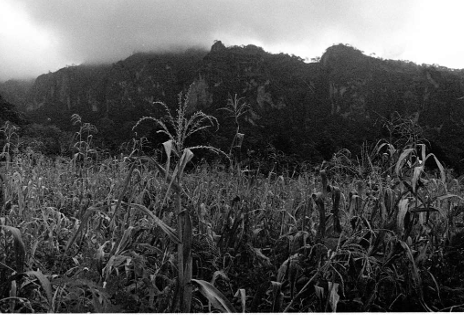
La Milpa de Santo Domingo, taken by Fime de la Fuente Ramírez and developed by Mar Dyer.
The USMCA ruling exemplifies how the production and legitimization of “scientific evidence” are weaponized by Empire through a historical process of neoliberal governance which enforces a moral and epistemic consensus, making corporate control appear inevitable and rational. To challenge global hierarchies manufactured through law, capital, and knowledge, we propose rerooting legitimacy from below through an emancipatory agroecology that resists co-optation and reclaims evidence as a tool for self-determination rather than control. This means agroecologists also need to confront the political and financial structures that their institutional credibility is entangled with and cede credit to alternative forms of knowledge.
Imagine a fourth food regime, one characterized by small-scale localized food systems, participatory decision-making, a thriving commons, and centering those most impacted (historically and presently) by the socioeconomic consequences of agricultural production. If we look back in history, insufficient, toxic, unequal systems have been dismantled before. As seen from cuts to research funding and the extermination of life-serving environmental agencies, the science industrial complex is already cracking.
—
Megan Gross is a PhD student at the University of California, Santa Cruz studying agroecology, science and technology studies, and abolition ecologies. Formerly, she worked in radio, data analytics, farming, and food justice organizing. She is committed to dismantling Empire and transforming food systems into worlds that affirm all life. Fime de la Fuente is a graduate student at the University of Michigan. He has worked in the political ecology of GMOs in Maize and Cotton in their center of origin and diversity (Mexico). Now he studies the political economy of coffee in Borikén, and particularly the cooptation of Agroecology as “business solution to poverty” that serves public-private partnerships but leaves smallholders out.
The Political Economy of Science issue is also available in print. Subscribe/purchase this issue to read it today.
Notes
[1] For terminology, we employ “the state” when we refer to artificial, non-permanent, socially grounded, geopolitical entities that legitimize power through violence in a given territory. That said, we feel that “the state” can be deficient in communicating the additional “deterritorialized network of power” that manages and directs the global order by creating hierarchies that prioritize capital, settler colonial ecologies such as property rich states over everything, which we call “Empire.”
[2] Matthew Wills, “Translating Corn,” JSTOR Daily, November 22, 2023.
[3] Alma Piñyero-Nelson et al., “Transgenes in Mexican Maize: Molecular Evidence and Methodological Considerations for GMO Detection in Landrace Populations,” Molecular Ecology 18, no. 4 (2009): 750–61, https://doi.org/10.1111/j.1365-294X.2008.03993.x; Alberto Santillán-Fernándezet al., “Relationship Between Maize Seed Productivity in Mexico Between 1983 and 2018 with the Adoption of Genetically Modified Maize and the Resilience of Local Races,” Agriculture 11, no. 8 (2021): 737, https://doi.org/10.3390/agriculture11080737.; Elizabeth Fitting, “Importing Corn, Exporting Labor: The Neoliberal Corn Regime, GMOs, and the Erosion of Mexican Biodiversity,” Agriculture and Human Values 23, no. 1 (2006): 15–26,https://doi.org/10.1007/s10460-004-5862-y.
[4] CONACYT, Scientific Dossier on Genetically Modified Corn and its Effects, (Mexico City, 2025), accessed August 27, 2025; Agreement US Mexico
[5] Ivette Perfecto, John Vandermeer, and Angus Wright, Nature’s Matrix: Linking Agriculture, Conservation and Food Sovereignty(London: Earthscan, 2009); Ulrich Hoffmann, “Reclaiming Food Systems: Agroecology and Trade,” in Feeding the People: Agroecology for Nourishing the World and Transforming the Agri-Food System, ed. Angelika Hilbeck and Bernadette Oehen (Brussels, Belgium: IFOAM EU Group, 2015), chap. 4, 22–25, https://orgprints.org/id/eprint/29950/
[6] Hernandez-Lopez, “Corn War,” 64–94.
[7] Maywa Montenegro de Wit and Alastair Iles, “The Evidence Project: Genetic (geo)engineering in a climate-changing world,” Elementa: Science of the Anthropocene 12, no. 1 (2024): 00005, https://doi.org/10.1525/elementa.2024.00005.
[8] Achille Mbembe, Necropolitics, trans. Janet MacConville (Durham, NC: Duke University Press, 2019).
[9] Primo Feliciano Velazquez, Códice Chimalpopoca: Anales de Cuauhtitlan y Leyenda de los Soles, Mexico City: Universidad Nacional Autónoma de México, 1992.
[10] Javier Pérez-López et al., “The Unbearable Lightness of Gene: Spatiotemporal Assessment of Transgenes in Mexican Maize,” In process; George A. Dyer et al.,, “Dispersal of Transgenes through Maize Seed Systems in Mexico,” PLoS ONE 4, no. 5 (2009): e5734, https://doi.org/10.1371/journal.pone.0005734; Kristin L. Mercer and Joel D. Wainwright, “Gene Flow from Transgenic Maize to Landraces in Mexico: An Analysis,” Agriculture, Ecosystems & Environment 123 (2008): 109–115, https://doi.org/10.1016/j.agee.2007.05.007.
[11] Robert Hansell, “‘Sin Maíz, No Hay País’: How Free Trade Hurts Indigenous Food Sovereignty in Mexico,” Center for World Indigenous Studies, February 13, 2025, https://cwis.org/2025/02/sin-maiz-no-hay-pais-how-free-trade-hurts-indigenous-food-sovereignty-in-mexico/.
[12] Institute for Agriculture and Trade Policy, Swimming Against the Tide: Mexico’s Quest for Food Sovereignty in the Face of U.S. Agricultural Dumping, (May 2023), https://www.iatp.org/sites/default/files/2023-05/swimming-against-tide.2.pdf.
[13] Agreement US Mexico https://ustr.gov/sites/default/files/Final%20Report%20ENG.pdf
[14] Maywa Montenegro de Witand Alastair Iles, “Toward Thick Legitimacy: Creating a Web of Legitimacy for Agroecology,” Elementa 4 (2016): 000115, https://doi.org/10.12952/journal.elementa.000115.
[15] Harriet Friedmann and Philip McMichael, “Agriculture and the State System: The Rise and Decline of National Agricultures, 1870 to the Present,” Sociologia Ruralis 29, no. 2 (1989): 93–117, https://doi.org/10.1111/j.1467-9523.1989.tb00360.x. .
[16] David Bollier, Think Like a Commoner: A Short Introduction to the Life of the Commons (Gabriola Island, BC: New Society Publishers, 2014).
[17] Philip McMichael, “A Food Regime Genealogy,” The Journal of Peasant Studies 36, no. 1 (2009): 139–69,https://doi.org/10.1080/03066150902820354.
[18] Hannah Kass, “Food Anarchy and the State Monopoly on Hunger,” The Journal of Peasant Studies 50, no. 3 (2023): 1187–206,https://doi.org/10.1080/03066150.2022.2101099.
[19] Adam Calo et al.,“The Enduring Fantasy of ‘Feeding the World,’” Spectre Journal, (2025), Accessed September 4, 2025.
[20] Phillip McMichael, Food Regimes and Agrarian Questions, (Rugby, UK: Practical Action Publishing, 2014).
[21]Philip McMichael, “Globalization: Myths and Realities,” Rural Sociology, 1996.
[22] Michael Hardt and Antonio Negri, Empire (Cambridge, MA: Harvard University Press, 2000).
[23] John Narayan, “Huey P. Newton’s Intercommunalism: An Unacknowledged Theory of Empire,” Theory, Culture & Society 36, no. 3 (2019): 57–85.
[24] Hardt and Negri, Empire, 36.
[25] Agroecology Summit ‘Outside Empire’ Subgroup, “A Declaration of Commitments toward Agroecology Pluralities: A Critical Gaze on the U.S. Agroecology Summit 2023,” Journal of Agriculture, Food Systems, and Community Development 13, no. 3 (2024): p. 86.
[26] ‘Outside Empire’ Subgroup, “A Declaration of Commitments,” 87.
[27] The content and sentence structure of this question was inspired by a similar question: How do we reconcile the long history of state involvement in the destruction and commodification of commons with FSMs’ current campaigns to get states/interstate bodies to rule in the other direction? Can we expect such institutions to by and large change direction? Should we?
Antonio Roman-Alcalá, “Anarchism, Degrowth, and Food Sovereignty: Exploring Overlaps and Tensions,” Degrowth Journal Special Issue: Anarchy and Degrowth (July 2025).
[28] Theresa Ong et al., “Momentum for Agroecology in the USA,” Nature Food 5, no. 7 (2024): 539–41.
[29]Nils McCune et al.,“Peasant Balances and Agroecological Scaling in Puerto Rican Coffee Farming”, Agroecology and Sustainable Food Systems 43, nos. 7–8 (2019): 810–26, https://doi.org/10.1080/21683565.2019.1608348.x