
The Feudal Lords of Science
By Melas Ibirhg
Volume 27, no. 2, Political Economy of Science
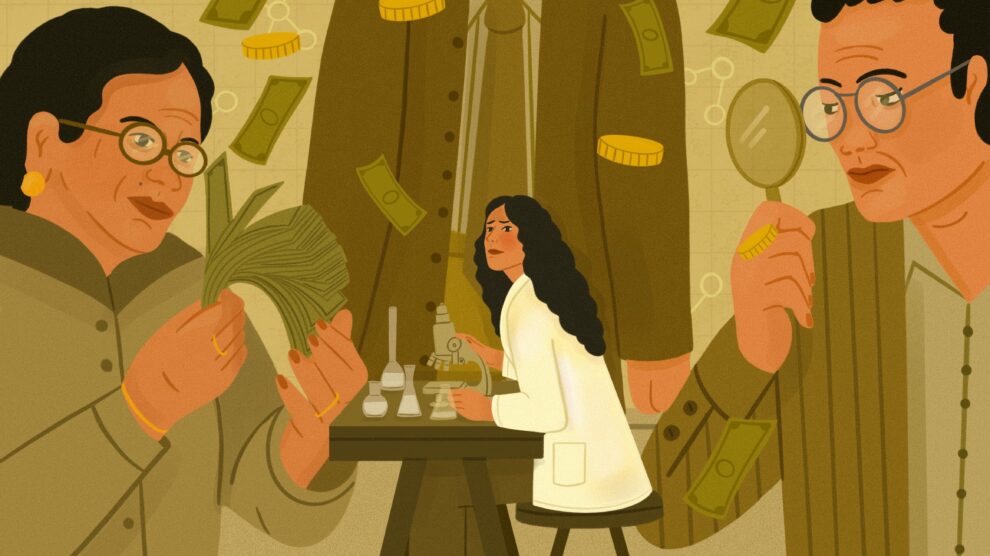
In Technofeudalism, economist and former finance minister of Greece Yanis Varoufakis uses the term to describe a system where a handful of tech platforms or corporations control the digital means of production (i.e., data, algorithms, platforms), extracting value from users much like feudal lords extracted rent from peasants, and concentrating wealth and power without market competition.1 Companies like Uber, Deliveroo, Amazon, and Meta do not produce goods themselves. Instead, they are virtual platforms where customers, sellers, and service providers meet. Their key power lies in being the central point where transactions occur. Without access to these platforms, vendors are effectively excluded from the market, marginalized, and eventually forced out. Similarly, a scientist cannot thrive without publishing research results and maintaining access to a publisher. Without published articles, securing funding, advancing in one’s career, or gaining recognition among peers is nearly impossible. Following Varoufakis, publishers are indeed the feudal lords of science.2
The history of scientific publishing dates back over 360 years, to 1665, when the Journal des Sçavans in France and the Philosophical Transactions of the Royal Society of London in England were first issued.3 During that period, journals were established to promote the advancement of science by building on the work of colleagues and reducing unnecessary duplication, while also introducing the concepts of scientific priority and peer review. By providing a structured and regular method for sharing research, they transformed scholarly communication, which had previously relied on personal letters, society meetings, and books, methods that had become overwhelming and inequitable for individual scientists. This systematic approach, coupled with broad and consistent dissemination, allowed scientific knowledge to be recorded, archived, and accessed more reliably.4
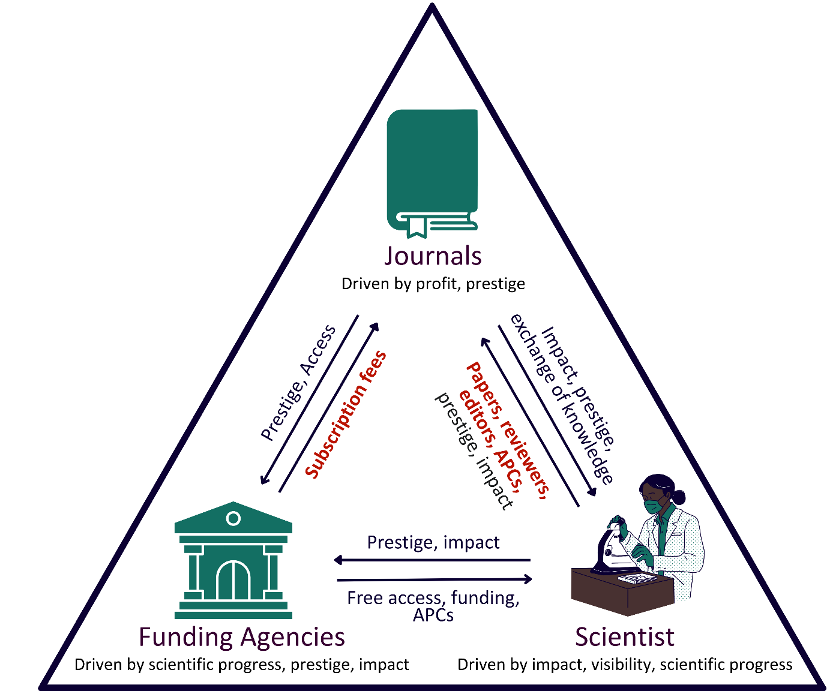
Today, scientific publishing is dominated by just five major companies (Elsevier, Wiley, Springer, Taylor & Francis, and Sage) that are collectively known as “the big five,” which together account for more than half of all scientific articles worldwide.5 These publishers sit at the apex of a triangle that defines modern science, with funding agencies (such as universities and research institutions) and researchers forming the two other corners. These actors engage with each other according to different interests, in a configuration that can be described as a kind of Bermuda Triangle of scientific publishing, where public money enters but then effectively disappears in an opaque system.
Within this triangle, publishers aim to maximize profit by increasing the number of articles they release while maintaining a certain level of quality, which varies between journals. High publication numbers enhance a publisher’s reputation, provide leverage in subscription negotiations, and, in the case of gold open access (where articles are freely available immediately and costs are paid by authors and indirectly by their institutions), generate revenue proportional to the number of articles published. Prestigious journal brands, such as Nature, can also be used to market additional services or other journals, such as paid conferences, books, podcasts, and affiliated journals.6
For researchers, publications serve as a stamp of quality that supports career advancement. The value of this stamp depends on journal-level metrics like the Impact Factor (IF) or Scimago Journal Rank (SJR).7 Researchers interact with journals in multiple roles: as authors, reviewers, and editors. As authors, they are not paid and, in the case of open access publishing, may even have to pay article processing charges (APCs) or depend on their institutions for payment. As reviewers, they receive no compensation and usually contribute either out of personal interest or from a sense of responsibility toward their scientific community of peers. As editors, they may or may not be paid, depending on the journal’s policies. In turn, researchers themselves are evaluated through metrics such as the h-index, which attempts to measure both productivity and citation impact by counting the number h of papers that have received at least h citations each.
In the case of the funding bodies, they often rely on journal stamps of quality to assess which researchers to hire, promote, or fund. Financial support from funding bodies sustains the entire scientific publishing system, and the funders themselves seek reliable, cost-effective, and informative indicators to guide their decisions. The publishers from this system make profits, directly or indirectly, in several ways (marked in red in Figure 1):
- Article Processing Charges (APCs): fees paid by authors (or indirectly their institutions) to make articles open access.
- Subscription fees: payments made by university libraries to access journals.
- Unpaid academic labor: the work of reviewers—and in many cases editors—whose time is effectively financed by funding agencies through their research salaries.
- Articles as commodities: publishers sell articles as their primary product, even though these works are produced at no cost to the publisher, since researchers are funded by public or private funding agencies.
Science for Profit: The Business Model Behind Modern Publishing
The combined incentives for publishers and researchers to increase output have led to a rapid inflation of the number of scientific articles published each year. In 2022, 2.82 million articles were published, compared to 1.92 million in 2016—an increase of 897,000 articles. This represents an average year-on-year growth of 5.6 percent over this period, despite the number of researchers remaining relatively stable.8 While increased output is not inherently problematic, it creates a tension between quantity and quality. Yet, defining “quality” is inherently difficult, and commonly used metrics can be manipulated, as cautioned by Goodhart’s law: when a measure becomes a target, it loses its effectiveness.9 For example, citation counts are often interpreted as indicators of impact, but they can be artificially inflated through self-citations or coordinated citation practices. The interplay of these incentives among funders, publishers, and researchers ultimately shapes the dynamics and output of the scientific publishing industry.
Moreover, these metrics reinforce global structural inequalities. University rankings, partly based on metrics like highly cited researchers, publications in Nature and Science, and papers indexed in major citation databases, serve a purpose and produce effects similar to the notorious ratings issued by international banks.10 Although they provide assessments based on highly arbitrary criteria, university presidents and administrators around the globe treat them with the same urgency and reverence that governments accord to annual sovereign credit ratings from Moody’s or Standard & Poor’s. It is not by chance that the distribution of university rankings and sovereign credit ratings closely mirror each other: countries with the highest credit ratings are also where top-ranked universities concentrate, revealing that this analogy is more than metaphorical—geopolitical and epistemic hegemony are two sides of the same coin.11
Scientists and institutions tolerate—or even rely on—these journals for several intertwined reasons. First, there is prestige: publishing in high-impact journals enhances the reputation of both individual researchers and their institutions, which in turn attracts funding, talented and ambitious students, and collaborative opportunities. Second, there is a pragmatic dependence: hiring, promotion, and grant decisions are often measured through metrics tied to these journals, making their influence unavoidable. Third, there is the illusion of authority and quality: the journals’ position at the top of the academic hierarchy creates a perception that their publications are inherently trustworthy and important, even when this may not always be the case. This situation mirrors the way states accept the authority of credit rating agencies, such as Standard & Poor’s, Moody’s, or Fitch. Just as governments allow these agencies to shape economic decisions, despite potential conflicts of interest or systemic flaws, scientists and institutions accept the dominant role of certain publishers, because doing so offers tangible advantages—prestige, visibility, and influence—even if it reinforces a parasitic structure.
From the publishers’ perspective, their dominant role appears natural, justified, and even indispensable for safeguarding scientific quality. As Casadevall et al. argue, publishers are essential providers of several functions: preserving the scientific record, arbitrating quality, raising standards, and promoting new research findings.12 They also claim responsibility for managing ethical issues and cases of misconduct, as well as for training peer reviewers and editors, who generally work for free.
However, many of these reasons are debatable in the internet era, and some are contradicted by the realities of modern scientific publishing. For instance, the function of preserving the scientific record is less critical today than it once was, since research outputs are now stored and accessible in multiple open online repositories, unlike in the past when journals were available only in printed form. At the end of the day, these justifications do not explain the enormous profits of private publishers or their tendency to form an oligopoly, exploiting the mechanisms of capitalist science while remaining firmly on their thrones like feudal lords. Their market power allows them to dictate access to knowledge, set subscription prices far above inflation, and impose APCs that can reach several thousand euros per paper. The profit margins of these publishers regularly surpass those of tech giants, luxury brands, and even pharmaceutical companies. Elsevier, for example, reported an operating margin of 33.9 percent in 2024, up 0.8 percentage points from 2023. Springer Nature generated €1.847 billion in revenue, while Wiley reported €1.617 billion in revenue and a 22.8 percent margin in 2024.13
All this revenue is almost entirely derived from public money, funneled into the publishing system through the four mechanisms described above. In other words, publishers extract extraordinary profits from an ecosystem in which the public overwhelmingly bears the costs. Although private universities and nonprofit foundations exist, they remain exceptions in many parts of the world, such as China or Europe, where most researchers are employed by public institutions and their projects are financed through national or supranational research funds. Even in the United States, where such private entities are more widespread, academic publishing continues to extract value indirectly from public resources, either through tuition fees paid by students or through the tax exemptions granted to nonprofit organizations. In all these contexts, the profits of scientific publishers ultimately stem from wealth that originates in the public sphere.
At the same time, the value produced—scientific knowledge—is locked behind their paywalls or monetized through APCs. This framework highlights the extent to which publishing has shifted from being a service to science into a highly lucrative business model. Moreover, the history of these corporations shows a systematic trend toward oligopoly through mergers and acquisitions. Elsevier absorbed North-Holland in 1970, while Reed acquired MDL Information Systems in 1986 and later merged with Elsevier in 1993. The real wave of acquisitions came with the rise of the Internet in 1997-1998, when Taylor & Francis and Reed-Elsevier expanded by acquiring multiple smaller publishers. Further peaks followed in the early 2000s, including Springer’s purchase of Kluwer in 2004. More recently, Elsevier bought Mendeley in 2013, Springer Nature was formed in 2015 through a major merger, and Wiley acquired Hindawi in 2021.14 Even MDPI, a relative newcomer, has grown rapidly, acquiring journals and launching hundreds of new journals to reach more than 430 by 2024, and its annual growth rate of open-access articles published exceeded 50 percent between 2016 and 2020, raising questions about the rigor of its peer review process.15
Peer Review and the Reproducibility Crisis: Quality Under Pressure
In 2022, MDPI had the shortest average review time, defined as the time taken from first submission to editorial acceptance, among major publishers—just 37 days compared to Frontiers (62 days), Hindawi (83 days), Elsevier (134 days), Wiley (145 days), Springer (157 days), Nature (185 days), and Taylor & Francis (197 days). Interestingly, this review time is consistent across different scientific fields; whether the research is experimental or theoretical, in the field of chemistry or mathematics, the average review period remains the same for a given publisher.16 Identical review times raise legitimate doubt that duration may be dictated more by the journal’s brand, built around quick turnover time, and internal processes rather than by the actual assurance of quality or careful evaluation of research content. For example, a highly experimental paper requiring extensive lab work should naturally take longer to meet a reviewer’s request for additional experiments than a theoretical mathematics paper.
A related issue is the so-called reproducibility crisis, highlighted by a 2016 Nature survey, which reported that over 70 percent of researchers had tried and failed to reproduce another scientist’s experiments, while more than half had been unable to reproduce their own.17 Some aspects of this crisis are inherent to the process: experiments can be technically complex, and small differences in conditions can yield divergent results. However, another aspect stems from the publication system itself. Studies may be rushed, carelessly conducted, or poorly reviewed. Moreover, the pressure to publish frequently encourages “salami slicing,” the practice of fragmenting a single research project into multiple minimally publishable units. This not only inflates publication counts but also contributes to the reproducibility problem, as each fragment may lack the methodological or contextual detail needed for replication. Although many label MDPI as a predatory publisher, its rise among and beyond the so-called big five highlights a broader structural problem beyond any single journal.18 In a system where the dominant imperative is publish or perish, it is inevitable that some actors will design business models prioritizing volume over scientific integrity. How, then, can anyone be surprised by MDPI’s “success”—publishing more articles and doing so faster—when the very logic of modern capitalist science rewards precisely that behavior?
Reclaiming Publishing: From Feudal Rent to Scientific Common
Taken together, these examples reveal that scientific publishing functions less as a service to science and more as a feudal rent extraction system. Publishers act as gatekeepers of recognition and career advancement, while universities and funding bodies reinforce the dynamic by evaluating productivity based on publications in branded journals. In this sense, the researcher’s position resembles that of a serf: obliged to render labor and resources to the publishing lords in exchange for the symbolic currency of legitimacy. The question that remains is whether the scientific community can break free from this oligopolistic grip and reclaim publishing as a commons, serving collective progress rather than private profit.
Although peer review is currently exploited by private publishers as a source of profit, it remains one of the cornerstones of the scientific community and cannot be eliminated. The challenge, therefore, is not to abolish it but to liberate it from the control of commercial oligopolies and reimagine publishing as a system that genuinely serves knowledge and society. This requires both cultural and structural change. Researchers, universities, and funding bodies need to adopt practices that weaken publishers’ hold over academic recognition and career advancement. Simultaneously, governments and institutions must create new infrastructures that make it possible to share and evaluate scientific work outside the profit-driven logic of the big five.
Some possible directions for reform are already visible, even if none of them alone can solve the structural problems of scientific publishing. One immediate step would be for researchers to prioritize non-profit journals, such as those run by scientific societies, which reinvest their resources into advancing science rather than generating private profit. This is certainly not a radical solution, but it is a concrete step in the right direction, and it helps to begin shifting prestige and credibility away from the major commercial publishers. At the same time, it is crucial to move beyond journal-based metrics such as the h-index or the impact factor, which have become instruments of power for publishers.19 The San Francisco Declaration on Research Assessment (DORA), signed by thousands of institutions worldwide in 2012, calls for precisely this shift: to evaluate research on its own merits rather than on the prestige of the journal where it appears; to recognize diverse outputs such as datasets, software, preprints, and methods; and to give proper value to contributions like teaching, mentoring, and collaboration.20
Another essential step concerns open access. Although conceived with good intentions and certainly preferable to the paywalls of the subscription model, open access has often been transformed into yet another revenue stream for publishers. In some cases, they even profit twice, charging both subscriptions and APCs. Moreover, while in the past private companies had to pay through subscriptions to access research produced with public money, today the cost is often covered by research grants provided to researchers themselves, and private companies can access this research freely and exploit it for profit. Without legislative intervention to create fairer and more transparent models, open access risks becoming just another form of double exploitation. An alternative would be to imagine publishing infrastructures owned and governed by the scientific community itself. Experiments already exist: some journals, for example, give reviewers a discount on publication fees in exchange for their work. But more ambitious proposals have been discussed over time, such as sabotage—individual researchers refusing to review—or coordinated reviewer strikes, where all researchers collectively stop reviewing for one or more of the big five publishers. Ultimately, none of these reforms will be enough if science continues to be treated primarily as a field for profit rather than as a public good. Publishing must be re-centered as a commons, serving collective progress rather than private gain. Only then can the scientific community reclaim control from the oligopolistic publishers who dominate it today.
The Political Economy of Science issue is also available in print. Subscribe/purchase this issue to read it today.
Notes
- Yanis Varoufakis, Technofeudalism: What Killed Capitalism (Penguin Random House, 2024), 78.
- In this article, I focus only on STEM publishing, which has its own particularities. But the framework may be applied to academic publishing in general.
- Vincent Larivière et al., “The Oligopoly of Academic Publishers in the Digital Era,” PLoS One 10, no. 6 (2015): e0127502, https://doi.org/10.1371/journal.pone.0127502.
- Derek J. De Solla Price, Little Science, Big Science (Columbia University Press, 1963), 56–58.
- Larivière et al., “The Oligopoly of Academic Publishers in the Digital Era.”
- “Conferences,” Nature, accessed September 15, 2025.
- A journal’s impact factor refers to the average number of article citations over the course of a two year period. Similarly, the Scimago Journal Rank is a measure that accounts for the number of citations a journal receives as well as the relative prestige of the journal overall. Both metrics have been widely criticized for incentivizing poor scientific practices as both are frequently used by funding bodies and individual institutions in the decision making processes for providing funding for labs or promoting individuals, see Matthew E. Falagas, et al., “Comparison of SCImago journal rank indicator with journal impact factor,” The FASEB Journal 22 no.8 (April 11 2008): 2623-2628, https://doi.org/10.1096/fj.08-107938.
- Mark A. Hanson et al., “The Strain on Scientific Publishing,” Quantitative Science Studies 5, no. 4 (2024): 823–843.
- Kristen A. Hahn et al., “The Role of Professional Journals and Societies in the Future of a Field: A Reflection on the Partnership Between the American Journal of Epidemiology and the Society for Epidemiologic Research,” American Journal of Epidemiology 183, no. 5 (2016): 367–71, https://doi.org/10.1093/aje/kwv191.
- Domenico Fiormonte, “The Algorithm Which Imprisons the Research.”
- “ShanghaiRanking’s Academic Ranking of World Universities;” “S&P Global Ratings,” S&P Global, accessed November 10, 2025.
- Arturo Casadevall et al., “The Changing Roles of Scientific Journals,” mBio 15 (2024): e02515-24, https://doi.org/10.1128/mbio.02515-24.
- “Annual Reports,” RELX, accessed October 1, 2025; “Springer Nature Annual Report 2024,” Springer Nature, accessed October 1, 2025; “Wiley, Significantly Expands Profit Margins, and Reaffirms Fiscal 2026 Growth Targets,” STM Publishing News.
- “Confirmed: Elsevier Has Bought Mendeley For $69M-$100M To Expand Its Open, Social Education Data Efforts,” accessed September 15, 2025; “SPRINGER NATURE created following merger completion,” accessed September 15, 2025 “Wiley Announces the Acquisition of Hindawi,” accessed September 15, 2025; Larivière et al., “The Oligopoly of Academic Publishers.”
- Hanson et al., “The Strain on Scientific Publishing”; “MDPI Journal List,” MDPI, accessed September 15, 2025.
- Hanson et al., “The Strain on Scientific Publishing.”
- Monya Baker, “1,500 Scientists Lift the Lid on Reproducibility,” Nature 533, no. 7604 (2016): 452–54.
- Predatory journals are typically defined as publishers that prioritize rapid publication and profit over rigorous peer review, and MDPI is often placed in this category because of its high volume of special issues, fast turnaround times, and concerns raised by some researchers about review quality.
- J. E. Hirsch, “An Index to Quantify an Individual’s Scientific Research Output,” Proceedings of the National Academy of Sciences 102, no. 46 (November 15, 2005): 16569–72, https://doi.org/10.1073/pnas.0507655102.
- “San Francisco Declaration on Research Assessment,” DORA, accessed September 15, 2025.