
Oxy-morons: The Arctic, US National Defense, and the University of Maine’s Climate Change Institute
By Eric Brown
Volume 27, no. 2, Political Economy of Science
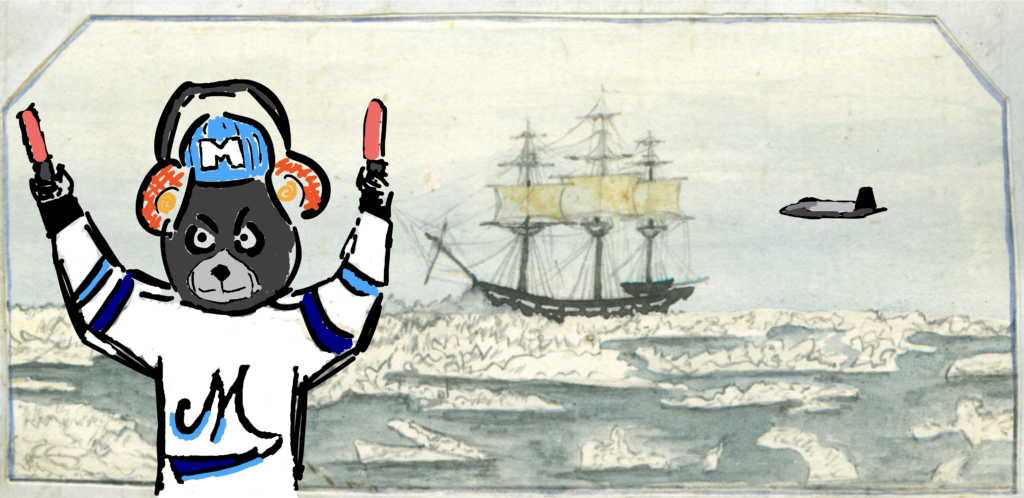
Today we find ourselves still, maddeningly, in an inane vortex. Anthropogenic climate change is accelerating and a new (or continued) Cold War is maturing, one feeding into the other and back again. The present ecocide is exemplified by the liquifying Arctic, which is increasingly being mutilated by jet exhaust and transoceanic ballast. Especially since US President Obama’s regime announced its “Pivot to Asia” in 2011 to prioritize confrontation with a rising China, the Arctic has become an increasingly important arena for geopolitics and commercial development. It holds as-yet unexpropriated resources and shipping passages inaccessible since time immemorial. As winters fail year after year to restore sea ice coverage, the United States, its proxies, and China and Russia square up to secure access. The result has been a counterproductive investment in the degradation of the world’s climate for a “gift of nature” while turning a blind eye to nature’s intensifying revenge.
Unabated decay of a frozen Arctic has inspired serious investment in the projection of US military power, and the Department of Defense’s (DoD, recently nominally restored to the Department of War) contracted lackeys are hard at work to ensure US military infrastructure can operate as effectively as capital interests require. For readers familiar with Brown University’s Costs of War project, the amplified presence of “the single largest institutional producer of greenhouse gases in the world” in the vulnerable Arctic ecosystem probably isn’t all that comforting.1 While corporate US media interest in President Trump’s desire to acquire Greenland from Denmark earlier this year waned almost immediately, the momentum to build US power projection in the region is as heightened as ever. Whether or not a physical US presence in Greenland extends beyond its Pituffik Space Base in the northern part of the island, the groundwork has been laid in the past 10–20 years to ensure the primacy of US capital in the Arctic.
A principal player in this developing strategy has been the state of Maine, which has been designated as an “Arctic state” despite being over 2000 kilometers from the Arctic Circle. Apparently, our ports, military infrastructure, and state university system uniquely qualify Maine to aid in the existential mission to secure US capital investments in and through the Arctic. So the story goes. Indeed, my colleagues at the University of Maine (UMaine) Climate Change Institute are doing their part as good superpatriots to investigate shifts in weather, snowpack, and other biogeochemical dynamics throughout the Arctic at the direction of the DoD and Department of the Air Force for improved military operation. Our institute’s scrupulous Director Paul Mayewski must’ve been stuck on an ice floe without a satellite phone when these projects were proposed given that he believes “[the Climate Change Institute]…is dedicated to improving the quality of life for people in Maine and around the world, and promoting responsible stewardship of human, natural and financial resources, now and in the future. The age of climate decision is here, and our actions will define the course of civilization and the health of our planet.”2 Responsible stewards of the planet, eh?
Maine: Arctic Outpost of New England
If we were to take the word of the Washington DC-based Arctic Institute, a self-described think tank founded in 2011 for “secure, just and sustainable” Arctic policy, we might get the impression that China and Russia are dragging the United States and its North Atlantic Treaty Organization pals kicking and screaming into confrontation. Affirming this impression, US Senators Lisa Murkowski (Alaska–Republican) and Angus King (Maine–Independent) introduced the Senate Arctic Caucus in 2015 by referencing the “aggressive national plans” of Russia and Canada to “develop Arctic resources and advance commerce in the North.” By championing an “‘Arctic Opportunity’ campaign to convince the rest of the United States that the Arctic should be a national priority,” the Senators have vied to restore that glorious American virtue—leadership (in resource extraction).3 King and Murkowski’s efforts have since compelled the DoD to initiate an Arctic Defense Initiative, multiplied investments in commercial and military-industrial infrastructure and manufacturing in Alaska, Maine, and the Pacific Northwest, and birthed an Ambassador at Large for Arctic Affairs in 2024. Kicking and screaming the United States must go, but Senator King thinks we can at least squeeze some luxury cruises out of the situation.4
King has appealed to historical trade in the North Atlantic in developing the case for an Arctic Maine even though such Arctic aspirations, rooted in historical commerce, have been laughed off for Asian observers to the Arctic Council.5 Central to King’s mythology are the deep-historical trade routes of Indigenous peoples in the Arctic and sub-Arctic whose cultures are bandied about as one of many noble causes for such investment in the Arctic mission.6 He seems to have forgotten celebrating his Wabanaki constituents’ histories while shooting down the Advancing Equality for Wabanaki Nations Act from Fiscal Year (FY) 2023 appropriations to support economic development for Wabanaki peoples in Maine.
Paying lip service to Indigenous sovereignty and security has merely been a garnish on a paranoid fear of some Red Menace invading from the north, presumably through Alaska or Canada.7 US national security concerns conveniently neglect historical reality, as it is true that the United States has waged war on and flouted the sovereignty of Russia and China in the past—not the other way around. And while King has been pushing for the United States to finally sign on to the United Nations Convention on the Law of the Sea (to which Russia and China have been parties since the 1990s), he somehow misses the irony of saying that “we must not allow the Arctic to go the way of the South China Sea, where freedom of navigation operations become necessary to emphasize international law.”8
If Russia’s modernizing of Soviet-era military infrastructure within its own territory at a time of continued NATO expansion is a mounting threat of aggression towards the United States, then let’s inspect King’s Maine redoubt. Despite being one of the most rural and least populated states, Maine is integral to the infrastructure of the US military. The Bangor International Airport, formerly Dow Air Force Base, remains the northeasternmost airfield in the United States capable of servicing military aircraft transiting the Atlantic. A few minutes down the road, the University of Maine hosts Army and Navy Reserve Officers’ Training Corps (ROTC) programs and regularly aids in recruiting for the Maine National Guard.
Not just a good host to predatory recruiters of would-be superpatriots, the UMaine System is also a founding member of the Maine Defense Industry Alliance, which provides a hub for major military contractors and service sites. General Dynamics’ Bath Iron Works and Saco Weapon Systems manufacturing plant, the Navy’s Portsmouth Naval Shipyard, and Pratt & Whitney are notable partners. Chancellor and disgraced former Governor of Connecticut Dannel Malloy explains, “Maine’s public universities are partnering with employers to address [the limited growth of Maine’s defense industry], including by expanding our engineering and computing programs, and hands-on student research learning experiences.”9 According to UMaine’s Office of Research Administration, in just the past decade, DoD investment at the university has shot up 700 percent—up from ~$8,200,000 in FY 2017 to nearly $66,000,000 in FY 2025. The University of Maine is an enthusiastic partner in the spoliation of youth and labor for a destiny of warmaking. Go Black Bears!10
That’s all well and good, but what about Senator Murkowski’s concern about “assess[ing] the accuracy of Arctic weather and water forecasting and analyz[ing] gaps in Arctic weather and sea ice observing networks in the U.S. Arctic region”?11 Well, luckily the UMaine System’s administrators have even more to brag about because the Climate Change Institute’s got some superpatriots of its own willing to roll up their sleeves for Uncle Sam’s commercial interests.
The Climate Change Institute: Skiff in a Whirlpool
Unsurprisingly, UMaine’s engineering programs claimed ~82 percent of awarded DoD funds in FY 2025, particularly for materials science projects. More unsettling, I think, is that the Climate Change Institute and School of Earth and Climate Sciences pulled in ~13 percent of the DoD cut in FY 2025—a bit over $8,000,000. Since 2023, my superpatriot colleagues at the Climate Change Institute and School of Earth and Climate Sciences have secured multiple DoD grants to assist the Senate Arctic Caucus in its mission, including $1,504,063 from a 2023 award for “Quantifying Spatial and Temporal Variability of Temperate Snowpack Properties using Coupled Radar, Remote Sensing, and Modeling Techniques,” $9,000,021 in a 2024 award for a project on the “Impacts of spatial-temporal precipitation, snowpack properties, and snowmelt variability on alpine landscapes and runoff,” and another $259,999 in 2024 for the “UMaine Support for United States Air Force Weather Project” directed at assisting the Department of the Air Force’s Air Force Weather. Neglected in these figures, of course, are projects serving the Pentagon that have been shunted from direct DoD funding to grants supplied by the Department of Energy, National Aeronautics and Space Administration, National Oceanic and Atmospheric Administration, National Science Foundation, and others.12
What to make of an institute whose mission is contradicted by its research programs? The Climate Change Institute (CCI, formerly the Institute for Quaternary Studies) has a decades-long, respected history in academia for its polar and high-altitude expeditions. Our institute’s expertise in climatology, glaciology, and paleoecology has fostered global collaborations and advanced much knowledge about the climates of the past ~2.5 million years. Suckling from the DoD teat is stupefying when the CCI’s research endeavors have aimed at understanding the dynamics of climate change past, present, and future within a mission of responsible stewardship of the planet. Stupefying, that is, until we appreciate that the climate change conversation has over the past few decades shifted from one of prevention to one of resilience and adaptation with seemingly complete buy-in—and that the DoD has been funding climate change research since the 1950s.13 Many academics have rolled over and swallowed the sham of naturalized capital and all its nonsensical co-conspirators (ecosystem services, carbon credits, and so on). The consequence has been the notion that expropriation of nature is not only desirable, it’s even responsible.14
As a result, we get principal investigators like Chris Gerbi who are excited to “…[characterize] and [predict] the characteristics of snow-covered regions [to fill] a critical gap in the US Army’s readiness to respond to sub-Arctic and Arctic threats.…”15 We get Seth Campbell, Director of Research for the Juneau Icefield Research Program (JIRP), who’s appreciative that “…this funding also supports JIRP and allows us to integrate the student participants more fully into the research projects we’re doing [on behalf of the Department of Defense].”16 As a scientist, Campbell thinks helping the Air Force operate in the Arctic is “…important because it helps us characterize where we’re at from a science perspective, and potentially where we’re going.”17
Where we’re going is toward unnecessary, preventable ecological catastrophe, and a head in the sand won’t change that. With $6,500,000 just awarded in June 2025 by DoD to UMaine’s engineering programs to investigate “Materials for Rapid Power Projection in Arctic and Contested Environments,” the CCI’s Arctic skiff is bound for bloodletting.
Conclusion
When academia’s role in the Military-Industrial-Etc.-Complex is known, it is typically because universities promote their involvement as a patriotic service (like the University of Maine System’s position in the Maine Defense Industry Alliance). Across the evolving Arctic, in a red-white-and-blue shroud, fellows at the Arctic Institute, soldiers-turned-PhD-students at West Point’s Modern War Institute, and their academic traitors-in-arms at the University of Maine vomit historical-revisionist and antiscientific nonsense to promote the United States’ Arctic ambitions.18 Less promoted are the actual consequences and implications of such nefarious associations, which have been detailed at length by worker-scientists in Science for the People in the past.
Another victim of the financialization of nature alongside its sister discipline ecology, climate science is being weaponized and the root cause of the climate crisis sidestepped for a payout from the foremost perpetrator of said crisis. In 1977, Science for the People’s John H. Vandermeer decried this collaboration:
Scientists and technicians, in their sadly naive attempts at remaining ‘objective’ in pursuing their ‘value-free’ science, have frequently been made into unwilling conscripts, who unwittingly serve the very cause of the problems they wish to solve….Ecologists…in a truly passionate desire to save the world from ecological disaster…have sometimes sacrificed a complete analysis of cause and effect for the pragmatic ‘what can we do here and now.’19
Long gone are the days when worker-scientists, especially those in the natural sciences, can claim ignorance about the consequences of their work. The gravity of climate and ecological crises for a humanity-sustaining world is clear, and it’s no mystery as to what and who are driving us toward ruin. Sometimes, as with the Climate Change Institute, which indeed does host so many researchers genuinely distraught at our lurching into climate catastrophe, what we do “here and now” requires that we take responsibility for “there and then.” Ecology and climate science workers must no longer stop just short of naming a solution: no more “we need more data” or “we leave it to the decision makers to find a path forward.” No more self-censorship. No more excuses. We have the data, and we are the decision makers. If we are to heed the alarm for ecological catastrophe, which has been wailing for decades, then we must get deadly serious about building real political power.
So, what’s to be done? Doubtless, from wherever you’re reading this, US-NATO militarism touches your life in some way. Luckily, that means there’s something you (and I) can do about it. Limitless inspiration exists in the worker and student-led opposition to Israel’s continued systematic slaughter and dispossession of Palestinians, the United States’ decades-long illegal siege of Cuba, and climate and ecological crises.20 Central to liberating our programs, departments, universities, research facilities, companies, etc. from associations with the Military-Industrial-Etcetera-Complex is organization.21 In our labor unions, which not only improve our living and working standards but also our ability to pressure employers on other issues, we have the power to forgo ruination and invest instead in a sustainable, just future.22 The same is true of innumerable student and community organizations such as Science for the People, Students for Justice in Palestine, Veterans for Peace, and Jewish Voice for Peace—and especially those concerned with local affairs. Do not underestimate the impact of having a say on your local school board or town council or bringing the issue to a society conference you’re attending.23 Together, it’s possible (and absolutely necessary) to reimagine what science does and for whom.
—
Eric Brown is an ecophysiologist based in Maine, USA and Sarawak, Borneo interested in the evolution of endothermy in mammals. He is an organizer with Science for the People, the UMaine Graduate Workers Union – UAW, and the Communist Party of Maine.
The Political Economy of Science issue is also available in print. Subscribe/purchase this issue to read it today.
Notes
- The Costs of War project is an ongoing investigation by researchers associated with Brown University’s Watson School of International and Public affairs to detail the environmental, social, and economic consequences of US militarism since 11 September 2001. Neta C. Crawford, “Pentagon Fuel Use, Climate Change, and the Costs of War,” Costs of War, Watson Institute, Brown University, November 19, 2019.
- “Climate Change Institute: Information,” University of Maine, accessed August 12, 2025.
- Senator Lisa Murkowski, “Floor Speech: Introduction of Senate Arctic Caucus,” March 4, 2015, U.S. Senate, accessed August 12, 2025.
- Despite demonstrating in a presentation that he understands the technical-scientific aspects of climate change and the catastrophic threats such change poses to human society, Senator King couldn’t resist musing about an opportunity for Maine to benefit from “possible tourism” through the Northwest Passage. Angus King, “Maine and Climate Change: The View from Greenland,” Margaret Chase Smith Policy Center, University of Maine, January 12, 2016.
- Calvin Heng and Eyck Freymann, “Outsiders Wanting In: Asian States and Arctic Governance,” Belfer Center for Science and International Affairs, Harvard Kennedy School, July 7, 2023.
- Angus King, “Maine and the Global Arctic,” The Wilson Quarterly, Winter 2022.
- Canada’s Operation LATITUDE provided support for the US-led military exercises Arctic Edge (US Northern Command) and Northern Edge (US Indo-Pacific Command) throughout the Alaskan region in August. Northern Edge has been conducted with nearly annual regularity since the 1970s under various names and supplemented since 2018 by Arctic Edge.
- King, “Maine and the Global Arctic.”
- “University of Maine System Leaders Help Launch Maine Defense Industry Alliance,” University of Maine System, March 1, 2024.
- UMaine’s spoliation of youth extends to at least sixteen juvenile black bears who had historically been impressed to be our mascot, Bananas. All sixteen ultimately perished from nutritional abuse. In recent years, researchers and students have conducted archaeological digs on the Orono campus to detail the steam plant hibernaculum, and likely final resting place, of the bears.
- Senator Murkowski, speech.
- Robert Krinsky, “Swords into Sheepskins: The Militarization of Higher Education Since World War II,” Science for the People Vol. 20, No. 1 (1988); Paul Selvin and Charles Schwartz, “Publish and Perish: The Integration of University Science with the Pentagon,”Science for the People Vol. 20, No. 1 (1988).
- Neta C. Crawford, “The US Navy and Climate Change,” Science for the People Vol. 25 No. 3 (2023).
- With the advent of nature as capital, ecology has become an accounting exercise—how much degradation can an ecosystem and its constituents tolerate? Capital’s carbon credit masquerade is merely time-limited protection (with terms often at odds with indigenous land rights) for chunks of already-existing ecosystems or ecologically inert monocrop plantations on already-capitalized land in exchange for continued permission to pollute elsewhere—a wholly anti-ecological scheme. In the information age, nothing has escaped the fetishist imperative to apply financial or technological fixes to our late-capitalist woes. The ecomodernists, sometimes even calling themselves socialists, insist that salvation lies not in a fundamentally new (socialist) economic relation which appreciates the material, ecological human-nature dialectic, but instead in acceding to the primacy of technology which will somehow decouple economic growth from its natural, material basis. If the impossibility of “something from nothing” in thermodynamics is negated by the prophecy of “something from nothing” in ecomodernism, then Futurama may as well call it quits for good. See the following for further analysis: John Bellamy Foster, “The Long Ecological Revolution,” Monthly Review, Vol. 69, No. 6 (2017); Ian Angus, “Hijacking the Anthropocene,” Climate & Capitalism, May 19, 2015.
- Sam Schipani, “School of Earth and Climate Sciences Awarded $1.5 million from DOD to Improve Snowpack Predictions,” UMaine News, September 5, 2023.
- Ashley Forbes, “DOD Awards $9M for Snowpack and Meltwater Research and Arctic Training Program in Alaska and New England,” UMaine News, September 30, 2024.
- Ashley Yates, “Air Force Partners with UMaine to Modernize Arctic Weather-Sensing Techniques,” UMaine News, April 23, 2024.
- Sylvia Jordan and Antonio Salinas, “Melting Frontiers: A Bold Vision for US Strategy in a Warming Arctic,” Modern War Institute, West Point, February 7, 2025.
- John H. Vandermeer, “Ecological Determinism,” in Biology as a Social Weapon, ed. The Ann Arbor Science for the People Editorial Collective (Burgess Publishing Company, 1977), 108–122.
- “A Climate Strike-Inspired Union Drive,” Science for the People Vol. 23, No. 2 (2020); Zakia Elliott, Alison Kenner, and Morgan Sarao, “Dignity Over Dumping: The Fight for Climate Justice and a Just Transition for Sanitation Workers,” Science for the People, Vol. 23, No. 2 (2020); Editorial Collective, “Resisting Technological Imperialism from Los Angeles to Palestine: Roundtable with Stop LAPD Spying and Palestinian Youth Movement,” Science for the People Vol. 24, No. 2 (2021); T.A. Tran and Leanne Loo (2023), “Resisting AFRICOM and Beyond: An Interview with Rose Brewer of Black Alliance for Peace,” Science for the People Vol. 25, No. 3 (2022); The Red Crate Collective, “Help for Science Education in Cuba and Vietnam,” Science for the People Vol. 3, No. 2 (1971); The Mapping Project, “Boston’s Colonial Universities Grab Land for Profit, War, and Medical Apartheid,” Science for the People, June 17, 2022; G. W. Castro, “The Struggle for University Divestment in the Age of Finance Capital,” Science for the People, October 16, 2024.
- For critiques of “horizontal” organizing and spontaneity, see the following: Jo Freeman, “The Tyranny of Structurelessness,” Science for the People Vol. 4 No. 6 (1972); Vincent Bevins, If We Burn: The Mass Protest Decade and the Missing Revolution(PublicAffairs, 2023).
- If your workplace has a union, pay your dues and get involved! If not, or your unit is unrepresented, check out the following resources to learn how best to empower yourself and your coworkers. Of course, history teaches that labor organizing methods are useful far beyond the workplace. Alexandra Bradbury, Mark Brenner, and Jane Slaughter, Secrets of a Successful Organizer (Labor Notes, 2016); Jane McAlevey, No Shortcuts: Organizing for Power in the New Gilded Age (Oxford University Press, 2016); Science for the People, Organize the Lab: Theory & Practice (People’s Science Network, 2022).
- “Resolutions for the AAAS,” Science for the People Vol. 2, No. 4 (1970): 26–27; Britta Fischer, “SESPA Tells It Like It Is: Opening Statement AAAS ‘70,” Science for the People Vol. 3, No. 1 (1971): 6–7; Steve Cavrak, Britta Fischer, and Amy Salzman, “AAAS Actions at Philadelphia: The Solidarity of the Long-Distance Activists,” Science for the People Vol. 4, No. 2 (1972): 4–10; Eric Brown, “Portland, Maine Votes to Divest from Israeli Genocide of Palestinians,” People’s World, September 17, 2024.