
Review
Capitalism Is Killing Us
By Nate Holdren
Volume 27, no. 3, Public Health
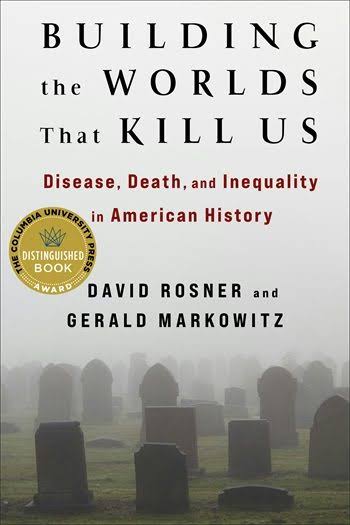 I worry about my kids. Cancer rates are high and rising here in Iowa where we live. We have major water quality problems due to the antisocial, ecocidal practices of the agribusinesses that dominate the state’s northern counties. There are two tire factories within a mile or two of my house and it’s hard to imagine meaningful regulation from the Republican ghouls running the state and federal government. I think most people could make similar lists, unfortunately. In the words of the public health scholars and historians David Rosner and Gerald Markowitz, we are all in worlds that kill some of us. That’s heartbreaking for the immediate victims and their loved ones and for everyone else who is well-informed and empathetic. Beyond heartbreak, the path forks, primarily, I think, between resignation and outrage, a difference with political stakes. Rosner and Markowitz’s new history of the United States, Building the Worlds That Kill Us, is a significant resource for helping people choose outrage.
The book begins with an account of the conquest and settlement of North America by England, focusing on the killing of a great many Indigenous people; the short, bleak lives of many English settlers; and the beginnings of a brutal slave society. This is a familiar story to many of us on the left, who have often read or heard second or third hand the contents of books like Howard Zinn’s justly famous People’s History of the United States, but it is a story that bears repeating. (In capitalist society, accounts are repeated or they are lost; there are no alternatives.) Furthermore, Rosner and Markowitz’s focus on health makes this more than a retelling. The book stresses that the United States is a society with structural power imbalances, and makes clear that such imbalances will always generate death and suffering in the form of obvious violence and in the form of patterns of ill health from disease, exposure, and deprivation that are often not understood as violence. This perspective beneficially links the histories of military campaigns against native peoples, the brutality of enslavement, the suffering inherent in poverty, the harms brought about by work, and epidemic disease into a single conceptual whole: All of these are harms that result from, as the book’s title states, “the worlds that kill us.” The book’s next three chapters walk the reader through US history up through the aftermath of the Civil War, providing accounts of industrialization, slavery, the ongoing harms of racism, and much more. The last of those middle three, chapter four, and even more so chapter five, get into the inequality and violence of what is often called the Gilded Age and some limited corrective responses tied to what is often called the Progressive Era and, in chapter five, the New Deal. The final two chapters take the story from the mid-twentieth century up through the recent present with brief discussions of the AIDS epidemic, climate catastrophe, and the COVID-19 pandemic.
Being a US historian myself, I admit to a strong bias here, yet I found the book’s overview of US history extraordinarily valuable for all the reasons that knowledge of the past is valuable. These reasons include a sense of, on the one hand, similarity between the present and the past: Just as we do today, people before have lived and died in lethal “worlds” for as long as class societies have existed. This point is made by the book with enough detail that it is not just an abstraction that lives in the narrowly intellectual parts of ourselves, but also comes to reside in our gut feelings, from which arise the sympathies and sensibilities we all feel and that interact in complex ways with our intellectually held positions.
I hesitate to say this, as I’m a historian rather than a literature scholar, but there is something important about longform nonfiction, a literary quality that makes the work resist summary. Literary works are in part experiential and have to be passed through in time, rather than being simply vehicles for content to be extracted in compressed form from texts. These elements act on us, shape who we are. With this particular book, one comes away horrified and disgusted. Alongside those negative feelings, there are positive ones like sympathy, empathy. These are all fighting feelings, solidaristic feelings. Or at least they can be, when organized correctly in texts and in the social contexts we’re in. That is to say, this book is affecting in a way that encourages us to be and to remain people who oppose structural violence.
There is an analytical power here as well. The book shows that over and over again “the worlds that kill” do so in concrete ways that change, which means that forms of opposition to that killing need to continually be remade: Dying at the hands of a colonizer’s military vs. smallpox vs. a coal mining disaster vs. air poisoned by leaded gasoline vs. any of a long list of horrors are similar in one sense, as elements of unjust and structural violence, and very different in that today’s victims and their allies cannot simply take up readymade the repertoires of activism developed by yesterday’s victims and allies. That is, the book places us in the context of ongoing historical processes and in doing so helps us to understand what is and is not unique to where we are now. I can imagine some readers understandably bristling at the US-focus, as people in all class societies have inhabited lethal worlds and learn much from looking across national boundaries and embracing political internationalism. At the same time, the degree to which the book tracks in some respects with conventional narratives of US history means that it can make its analytical points more quickly, since readers who have any knowledge of US history from schools, museums, or media will have an entry point for understanding what the book presents. Likewise, the book equips people to speak back to the dominant official narratives that are so prevalent in the present. In a sense the book helps readers understand that any mainstream account of the history of the United States is an account of a profoundly brutal society—of a world that kills. All of this makes the book very valuable and I hope it is widely read.
I framed the book in terms of helping people take a path of outrage instead of resignation. It does so well, insofar as the harms the book depicts are presented over and over again specifically as injustices to oppose. In my view this matters at least in part because understanding the harms people endure as unjust rather than merely tragic means that we understand the current violent world as something that could be done away with. To be outraged is to think and, more importantly, to feel as a matter of gut level conviction, that things must and thus can be better. It also matters that the book stresses that our outrage must be solidaristic: We are not willing to throw anyone to the wolves. This is crucial, as under pressures where real survival is at stake, it can become tempting to cut deals that write off people whom we are encouraged to think of as not part of the “we” to which we belong. I assume Science for the People readers are already on the latter path of solidaristic outrage, but this book can help us remain so and help others to meet us.
I understand much of the above under the heading of moral imagination, something crucial— absolutely necessary—for but also insufficient for left politics. In addition, and here Building the Worlds has important limitations, we need what I think of as social imagination. The book is in effect a history of the United States that centers on and is organized by the concept of social determinants of health. (The word “worlds” in the book’s title serves as a non-technical term for something like “actually existing set of social determinants.”) This is very valuable and it does contribute to some extent to our social imagination. At the same time, to be blunt, the concept of health’s social determination doesn’t get us very far without a related understanding of how capital conditions the social in capitalist societies.1 To put it another way, we can understand the harms that outrage us as either the result of decisions or as the result of structure. To use the words in Rosner and Markowitz’s title, it is important that the book encourages us to think of the ongoing killing that plagues our society as not simply the result of choices made by some people in a world, but rather as wrought by a world itself. That said, it is also important to explain why “we” keep building such lethal worlds over and over again and whether, and if so how, we can stop building them. The book only partly addresses this matter, ultimately treating poverty as the result of greed, racism as the result of racists, and so on. While I do think this is a good book, to put it very baldly, it would be better if it had been a Marxist book.
In my view, this book makes a wonderful contribution for readers who are already Marxists. This book’s rich narration and rigorously sourced account of what has happened in the United States over time provides us with a great deal of evidence for the kinds of things that our theoretical account predicts. I think something important happens cognitively when we think through, in some degree of concrete detail, what has happened in the actual world. This is something different from—though certainly complimentary with and which cannot replace—the important thing that happens when we think with the greater degree of abstraction or abbreviation that theory requires.
At the same time, for readers who are not Marxists, there are not only some serious limitations but also potential pitfalls. First, non-Marxist readers will not get a full and rigorously theorized account of the social phenomena the book presents and decries. Second, the book may end up serving as an ideological resource for reformist political forces which are an obstacle to real emancipation in the long term and, potentially, for liberal forces of civility who encourage people in struggle to be overly patient while they and their loved ones are being killed by capitalism’s murderous worlds.
Very simply, Marxism just does provide a better and more accurate account of the society we’re in. In the book’s terms, Marxism explains why “worlds that kill” continue to be built and will not stop being built until capitalism ends. In short, a society that prioritizes profit is not only incapable of prioritizing human flourishing and thus has to create neglect of specific people’s well-being, but also must actively generate violence of various kinds. Many reformers past and present have fought heroically to stop specific forms of neglect and violence, which is deeply laudable morally, but those efforts simply cannot address the real sources of the problems. Capitalism is not simply a collection of arrangements that just so happen to kill, but rather a type of society which must generate novel forms of lethality, i.e., continuously build new worlds which kill in ever changing ways. Thus, a social vision which focuses our attention on the specifics of the actually existing worlds, while useful for immediate fights for survival and relatively more justice, can only ever help us find exits from these lethal worlds into new ones that are newly and differently lethal. A social world that genuinely supports human flourishing can only be made by exiting capitalism and class society altogether, a project of deep urgency as this book lays out, and that requires a Marxist perspective to understand and actively enact.
I’ve stressed that this book should be intellectually supplemented by Marxism. I want to close by stressing the practical importance of direct action. The most effective forms of fighting back against the specific ways in which a particular world kills, tend to be those that disrupt business as usual and which do not occur via existing recognized (let alone professionally or civically rewarded) institutional pathways. That is, to borrow the old Panther phrase, in the short term our best option is often survival pending revolution. Direct action or socialism as a process of actively fighting to democratize social life in concrete ways—a process linking short-term struggles to survive and have better lives with the long-term project of revolutionary social re-organization—is crucial for revolution because it builds individual and collective dispositions and capacities important for radical politics.
Put bluntly, those among the oppressed who play nicer tend to die sooner. While struggles for a better world will tend to lead to the creation of important institutions like OSHA and the CDC and so forth—institutions which need to be fought for and defended so that they can serve our well-being—struggles cannot succeed if they occur primarily through those institutions. Those institutions are under fundamental constraints that limit their ability to disrupt the operations of capitalism, let alone to foster real forms of political power exercised in democratic forms by ordinary people. It is only popular power against, and thus in its smaller forms disruptive of and in its longer forms involving the revolutionary abolition of, capitalism that really points to the possibility of building worlds that do not kill us, let alone worlds that heal and enrich and enliven us.
Building the Worlds That Kill Us: Disease, Death, and Inequality in American History
David Rosner and Gerald Markowitz
Columbia University Press
2024
408 pages
—
Nate Holdren is a Marxist historian. He is the author of the book Injury Impoverished: Workplace Accidents, Capitalism, and Law in the Progressive Era (Cambridge University Press, 2020). He lives in Des Moines with his family.
Notes
- See Nate Holdren, “Social Murder: Capitalism’s Systematic and State-Organized Killing” in Marxism and the Capitalist State: Towards a New Debate, ed. Rob Hunter, Rafael Khachaturian, and Eva Nanopoulos (Palgrave Macmillan, 2023); and Nate Holdren, “Economic Power, Liberalism, and Crisis,” Legal Form (blog), January 20, 2023, https://legalform.blog/2023/01/30/review-essay-economic-power-liberalism-and-crisis-nate-holdren/.