
Guns, Curses, and Violent Ethics
Medical Fascism in the Philippines during the COVID-19 Pandemic
By Chuckie Fer A. Calsado
Volume 27, no. 3, Public Health
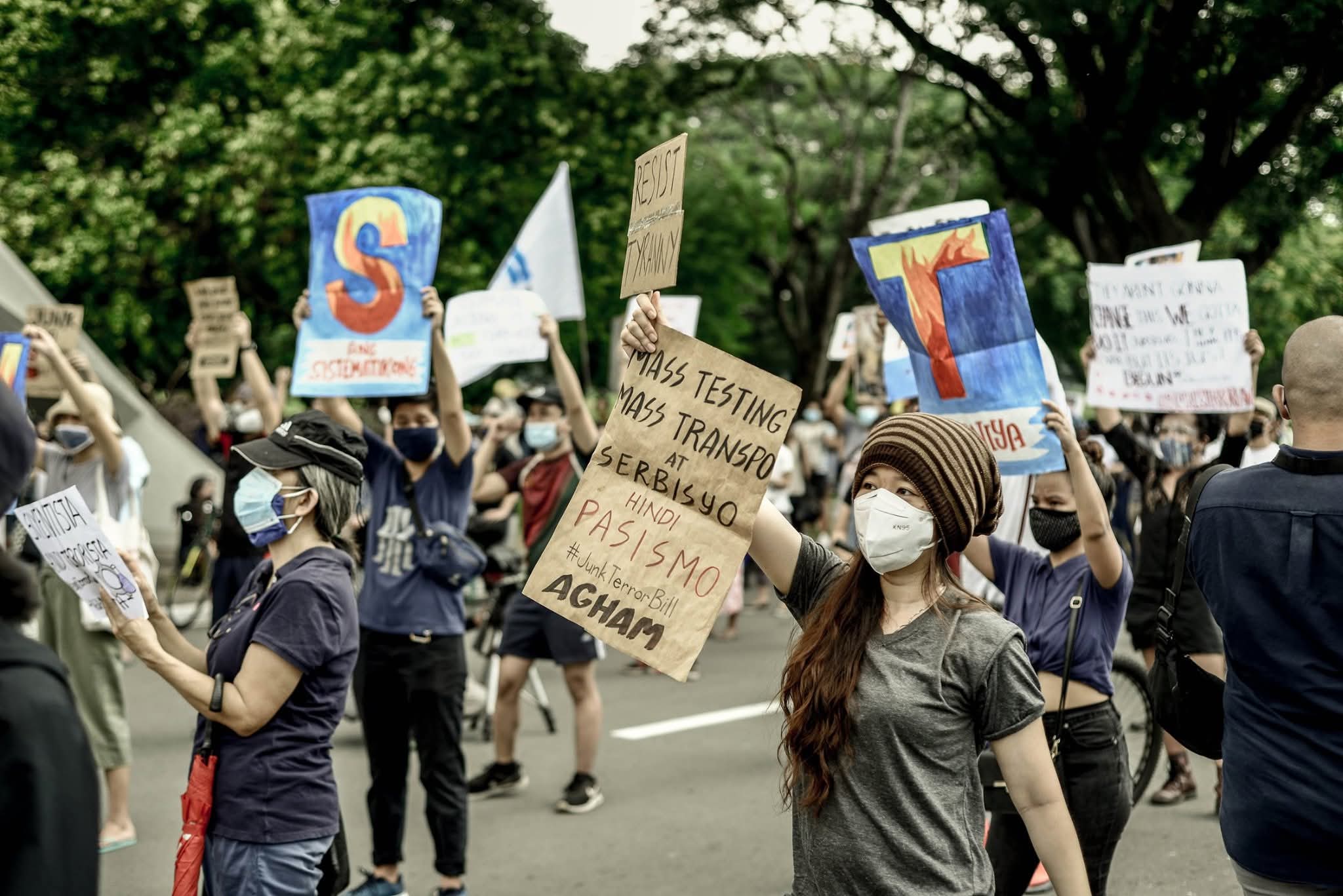
AT the height of the COVID-19 pandemic, public figures from Madonna to the governor of New York City claimed it the great equalizer, a disease that would eradicate class.1 The range of government responses stripped this generalized proclamation of its truth, instead revealing the class character of different countries. There is Sweden that relied on voluntary behavioral changes, a model premised on social trust but criticized for its impact on vulnerable populations, such as (school)children.2 Vietnam, a low-income country, deployed early and transparent public health measures such as mass contact tracing, targeted quarantine, and proactive communication that contained the virus at a fraction of the cost absorbed by wealthier nations.3 The United States promoted individual freedom while the pandemic’s burden fell with devastating disproportionality on Black and working-class communities, a disparity rooted not in biology but in the structural conditions of a racially stratified class society.4 At the far end of this spectrum stood the Philippines under Rodrigo Duterte, whose government imposed one of the world’s longest and strictest lockdowns, placed quarantine enforcement under the control of armed forces and the Philippine National Police, and ordered his forces to shoot lockdown violators dead.5 As Fanon observed, our material reality is primarily an economic condition and secondarily a racial (identity) one. Both aspects defined one’s COVID-19 risk.6
Where other governments at least performed a commitment to an acceptable public health ethics, the Duterte regime deployed military force, weaponized language, and colonized the ethical register itself to justify policies that punished the poor.7 This is the violent ethics of the ruling class. This language might register as an oxymoron, violence and ethics being contradictory, but I argue that this violent ethics serves those in power while at the same time punishing the exploited. Understanding these violent ethics—the use of ethical language, norms, and frameworks by those in power to morally justify policies that harm the exploited class— requires situating the pandemic response within the broader class contradictions of Philippine society. This article is a comparative analysis between violent ethics and the ethics of resistance.
The Guns: Militarizing a Health Crisis
Before the first guns were drawn and the first curses were hurled, the Duterte regime made its foundational class choice. On January 29, 2020, then Secretary of Health Francisco Duque III publicly rejected calls for a travel ban on mainland Chinese nationals, citing “political and diplomatic repercussions.”8 His concern was not about public health strategy, scientific evidence, or the Filipino majority’s right to the highest attainable standard of health, but rather about appeasing the imperialist interest of the new colonial master. In the spirit of scientific practicality or ethical conscience, we are then forced to ask the question, why? In a semifeudal and semicolonial society, those who hold power govern not through dialogue but through force, that is, through the imposition of their class interest on the lives of the exploited majority.9 The Duterte regime’s pandemic response made this governing logic explicit from its very first structural decision: a militarized lockdown response headed by uniformed personnel.10 This was a concrete manifestation of the regime’s class character, translating the health crisis into a “peace-and-order” problem—a war, in the president’s own language—to be fought by soldiers against an enemy that was never quite COVID-19 itself.11 The response is now a war against the people instead of a holistic medical response.
The war framing legitimized military and police enforcement of quarantine measures and criminalized the movement of ordinary Filipinos who could not afford to comply, that is, the pasaway in Filipino language. This is the militarized class imagination applied to epidemiology, where the pasaway became the primary object of pandemic governance rather than the virus itself. The burden of the pandemic was thereby displaced from the state, which lacked the will and infrastructure to mount a serious public health response, onto the bodies of the working class, whose failure to comply became the explanation for the crisis. An army veteran with post-traumatic stress disorder was shot dead, quarantine violators were imprisoned in a dog cage, another died of “exercise punishment,” and a number of activists were killed “tokhang style”–the extrajudicial killings that were normalized during the war on drugs during the Duterte regime.12
The militarization of the pandemic response was inseparable from the regime’s simultaneous deployment of another weapon: red-tagging, the practice of publicly labeling activists and critics as Communist Party members or affiliates, then frequently followed by threats and extrajudicial violence.13 Progressive organizations that called for a genuine, people-centered, pandemic response were labeled communist fronts. Lawyers who challenged the constitutionality of the lockdown measures were vilified.14 Most consequentially, the Anti-Terror Law (Republic Act No. 11479) was signed in July 2020, at the height of the pandemic, and immediately became a legal instrument directed at the same progressive sectors that had most vocally demanded a humane, science-based pandemic response.15 This was the regime’s McCarthyism: the colonized ruling class’s habit of misdirecting blame onto othered groups to avoid accountability for their own failures.16 These are the guns that enforced the regime’s limit situation—or the horizon of what Filipinos were permitted to imagine, demand, or resist.
The Curses: Language as Ruling-Class Violence
“Kung ayaw mo magpabakuna, ipaaresto kita at ang bakuna, itusok ko sa puwet mo. Putang ina, bwisit kayo,” —Rodrigo Duterte, addressing Filipinos who refused vaccination (“If you don’t want to get vaccinated, I’ll have you arrested then I’ll inject a vaccine into your buttocks. [Expletive], you are a nuisance.”)17
As has become his character, Duterte did not forget to curse the Filipino people during the pandemic. Alongside physical violence, the Duterte regime weaponized language itself as a form of governance. This is the act of naming of the world by the oppressor who, through their class privilege, determines what can be done, said, thought, or imagined as possible.18 The president’s nightly addresses were extraordinary documents of this naming, not because of their eloquence, but precisely because of their crudeness. When Duterte suggested that pandemic bodies could be thrown into Manila Bay because “the fish will get fat and taste better,” or told Filipinos that boiling cooking oil would kill the virus, he communicated with perfect clarity the class position of those in power: the Filipino poor were materials to be managed, not citizens to be protected. The absurdity of the unscientific content was inseparable from the content of the class message.19
The regime’s curses were not random. Those whose demands would have imposed costs on the ruling class were attacked. When a coalition of medical professionals called for a “timeout,” a request to return to stricter quarantine measures, they were not making a political demand.20 A stricter quarantine measure in the language of medical professionals directly confronts the violent language of the regime through its heavily militarized lockdown policies.21 They were making a scientific one, grounded in the material reality of hospital bed shortages, personal protective equipment (PPE) failures, and healthcare workers dying in service. The president’s response to this request demolished any pretense of medical authority in pandemic governance: “you animals if you are really bright then you could be in my position [as the president] and do what you want.”22 Those who proposed dialogue were punished by name-calling and delegitimization, because genuine dialogue in a class society requires conceding that the governed have knowledge the governors do not; this is a concession structurally intolerable to those in power.23 The “curses” in this essay’s title are therefore not only the expletives aimed at critics, but the entire discursive structure that cursed the Filipino people to passivity in a limited situation of a world named and bounded by those who hold power.
The Violent Ethics: Science and Morality in Service of Class Interest
The regime’s guns and curses were not incidental to its pandemic governance; they were its ethical framework made visible. The violent ethics of the ruling class is the active colonization of the ethical register itself, deploying ethical language, norms, and bioethical frameworks to morally justify policies that harm the exploited class. It is distinct from merely unethical policy. What makes the Philippine case analytically valuable is its extremity, as the militarized lockdown measures make the underlying mechanism visible where other governance models obscure it. The Duterte regime said out loud what other states merely implied: that the lives of the working class are the acceptable price for maintaining social order, and that the language of public health exists, in part, to make that price ethically legible. The regime did not simply fail to follow the science but co-opted science as a populist prop, using the language of scientific governance to legitimize decisions that were fundamentally political and economic.24 This is not mere medical populism, a political style deployed during health crises that pits the people against those in power. A class analysis insists on a deeper structure, one where medical populism in a semicolonial society is not an aberration of leadership personality, but an expression of the class character of neocolonial governance.
Duterte’s insistence on being the first to be vaccinated was the precise performative act of the representative of the ruling class, forcing the governed to follow.25 The president sold himself as the willing body and the people as the audience who is shamed into compliance. In a country where the working class had spent months reporting for work—with no adequate protective equipment, no hazard pay commensurate with the risk, and no guarantee of care if they fell ill—this performance was class coercion, not leadership, dressed in the language of sacrifice.26 Frontline workers had already been performing duties beyond what is expected of them at enormous personal cost. Rather than recognizing this sacrifice as the extraordinary moral act it was, the regime reframed vaccine access as a reward held out to ensure continued compliance to vaccination policy. When low uptake followed, a vaccine mandate was imposed, converting this perverted reward structure into a legal obligation.27 Ethical principles at the hands of those in power became a lever to compel compliance under threat of economic punishment, loss of livelihood, removal of access to relief, and more. The low uptake of vaccines was the predictable consequence of the structural violence of inaccessibility: inadequate sites, the impossibility of taking time off work, and the historical legacy of a state that had spent years defunding public health.28
At the most negative end of the spectrum of vaccination positions among the Filipino public, activists together with the health professionals who called for a holistic and safe quarantine response were falsely positioned as the primary force responsible for low vaccine uptake. The Duterte regime co-opted the very institution that should be leading the holistic medical response to the pandemic by legitimizing the transfer of responsibility for the regime’s failed vaccination program from the state to the exploited class, criminalized political opposition by linking activist identity to vaccine refusal, and dressed a class act of blame shifting in the language of public health communication. This is violent ethics at its most operationalized: the masses are dehumanized by a government graphic that weaponizes the language of public health to name the people as the problem.
The Ethics of Resistance
The violent ethics of the ruling class does not exist in isolation. It exists in dialectical contradiction with the ethics of resistance of the exploited class. The regime’s pandemic response was not met with passive suffering. Progressive organizations, basic sectors, health worker unions, community groups, and national minorities actively contested the terms through which the pandemic was governed. They named their own world, as the lockdown was not a public health measure but a class measure that preserved the economy for the oligarchs while starving the informal workers who had no savings and no social safety net. The vaccine-first, test-never strategy was not a rational public health choice but a diplomatic and commercial arrangement that served foreign pharmaceutical and geopolitical interests.29 Rather than being a security measure, the Anti-Terror Law was the legal institutionalization of state violence long directed at those who organized for the people’s welfare.30
The ethics of resistance is constructive rather than merely oppositional. It is a qualitatively distinct ethical framework rooted in the material conditions of the exploited, anchored in collective rather than individual moral reasoning, and oriented toward liberation rather than the maintenance of the existing order. Where the regime’s ethics asked “what is morally permissible within the current social arrangement?”, the ethics of resistance asks “what social arrangement is itself ethical?” This question does more than critique the Duterte regime’s pandemic response. It exposes the fundamental inadequacy of pandemic ethics debates mostly anchored on ethical abstraction rather than the material oppression of the working class. When institutions that are meant to apply frameworks, guidelines, and moral philosophies are themselves instruments of class domination, they produce not ethical analysis but ethical cover. When policies were anchored on individual behavior and freedom, blind to the exploitation of communities who bore the disproportionate burden, the language of autonomy was deployed to dissolve accountability for structural harm. As a tool of those in power, beneficence becomes doing good for those in power; autonomy is freedom permitted; justice is never divorced from the question of justice whom it serves. The lesson the Philippine pandemic teaches is not that the principles are wrong, but that principles without a materialist foundation permit the ruling class’s violent ethics to be deployed. For a pandemic ethics to be genuinely ethical, it must begin with class analysis, an honest reckoning of who carries the burden, who sets the terms, and whose suffering is treated as the necessary cost of the social order.
Conclusion
The COVID-19 pandemic in the Philippines exposed healthcare not as a neutral scientific and ethical domain but as a terrain of class struggle. The Duterte regime did not attempt to conceal the violent ethics of the ruling class: the guns were too visible, the curses too loud, the corruption too naked to maintain the fiction of a government acting in the public interest. They were a unified expression of the ruling class’s interest in preserving a social order in which the exploitation of the many sustains the accumulation of the few. That this exploitation took place in the name of public health, anticorruption, and scientific governance, dressed in the language of ethics, is precisely what makes this a case of violent ethics rather than merely unethical policies. The contrast with Vietnam, a country that faced the pandemic with fewer resources, a more transparent state, and a clearer commitment to collective welfare, and that achieved better outcomes by every measure, is not incidental. It is the essay’s counterargument in concrete form that a people-centered pandemic response was possible, that it was chosen or not chosen, and that the choice was a class choice.
The exploited class’s ethics of resistance refuses to evaluate these policies as technical failures or policy gaps to be corrected within the existing system. I insist instead on naming them as a violent ethics of class domination that is confronted, resisted, and challenged by the living ethics of the exploited. In the Philippines, the people who had the most to lose were also those who, through generations of resistance, had the clearest understanding of what a genuine ethics of care, self-determination, and liberation looks like. At the hands of the collective resistance of the people, ethics becomes life giving and life defending against the violence of the ruling class.
—
Chuckie Calsado (PhD) is a Filipino scientist-activist and bioethicist whose work sits at the intersection of decolonial ethics, climate justice, and community-embedded science. A UCL-trained researcher and National Chairperson of AGHAM (Advocates of Science and Technology for the People), he has spent over a decade working with communities and the Filipino diaspora to make SnT serve the people. Deploying theories of violent ethics and ethics of resistance, his scholarship exposes how dominant ethical frameworks reproduce colonial and class violence while centering how communities resist and reclaim knowledge on their own terms. @chuckiesapatero
Notes
- On the “great equalizer” claim, see Cynthia Godsmark, “COVID-19, Race, Class and the Great Equalizer Myth,” Media Diversity Institute, 2020, https://www.media-diversity.org/covid-19-race-class-and-the-great-equalizer-myth/; on Madonna’s remarks, see CNN, March 23, 2020, https://edition.cnn.com/2020/03/23/entertainment/madonna-coronavirus-video-intl-scli; on Governor Cuomo’s remarks, see Washington Post, April 5, 2020, https://www.washingtonpost.com/outlook/2020/04/05/gov-cuomo-is-wrong-covid-19-is-anything-an-equalizer/.
- Anders Björkman et al., “The Swedish COVID-19 Approach: A Scientific Dialogue on Mitigation Policies,” Frontiers in Public Health 11 (2023): 1206732, https://doi.org/10.3389/fpubh.2023.1206732.
- Era Dabla-Norris, Anne-Marie Gulde-Wolf, and Francois Painchaud, “Vietnam’s Success in Containing COVID-19 Offers Roadmap for Other Developing Countries,” IMF Country Focus, June 29, 2020, https://www.imf.org/en/news/articles/2020/06/29/na062920-vietnams-success-in-containing-covid19-offers-roadmap-for-other-developing-countries.
- Centers for Disease Control and Prevention, “COVID-19 Provisional Counts — Health Disparities,” updated July 22, 2020, https://www.cdc.gov/nchs/nvss/vsrr/covid19/health_disparities.htm; see also Godsmark, “COVID-19, Race, Class and the Great Equalizer Myth.”
- Charlie Campbell, “Rodrigo Duterte Is Using One of the World’s Longest COVID-19 Lockdowns to Strengthen His Grip on the Philippines,” Time, March 15, 2021, https://time.com/5945616/covid-philippines-pandemic-lockdown/; United Nations High Commissioner for Human Rights Michelle Bachelet described the response as a “highly militarised response,” quoted in ibid.
- Frantz Fanon, Black Skin, White Masks (New York: Grove Press, 1967), 4.
- On the concept of bioethics and its institutional deployments, see Tom L. Beauchamp and James F. Childress, Principles of Biomedical Ethics, 8th ed. (Oxford: Oxford University Press, 2019). The term is used here to name the dominant framework within which pandemic ethics debates were conducted.
- Ben Rosario, “Duque rejects ban on Chinese tourists, cites diplomatic, political repercussions,” Manila Bulletin, January 29, 2020.
- Amado Guerrero [Jose Maria Sison], Philippine Society and Revolution (Oakland: International Association of Filipino Patriots, 1979).
- Chuckie Fer A. Calsado, “Towards a Decolonized Critical Bioethics”: Class and the Ethics of Resistance in the Philippines” (PhD diss., University College London, 2023), 110.
- Calsado, “Towards a Decolonized Critical Bioethics,” 110.
- Alan Robles,“Coronavirus: Philippine Police Shoot Dead Army Veteran,” South China Morning Post, April 23, 2020, https://www.scmp.com/week-asia/health-environment/article/3081293/coronavirus-philippine-police-shoot-dead-army-veteran; Samuel Lovett, “Coronavirus: People Who Break Curfew Held in Dog Cages in Philippines as Human Rights Group Warns Against ‘Cruel’ Mistreatment ,” Independent, March 26, 2020, https://www.independent.co.uk/news/world/asia/coronavirus-phillippines-lockdown-curfew-dog-cages-latest-a9427621.html; “Covid Rule-Breaker ‘Dies After Exercise Punishment” BBC News, April 4, 2021, https://www.bbc.com/news/world-asia-56641398; For definition of ‘tokhang’, refers to the police knock-and-plead operations later associated with extrajudicial killings in Duterte’s war on drugs, see Danilo Andres Reyes, “The Spectacle of Violence in Duterte’s ‘War on Drugs,'” Journal of Current Southeast Asian Affairs 35, no. 3 (2016): 111–137, https://doi.org/10.1177/186810341603500306.
- Republic Act No. 11479, “Anti-Terrorism Act of 2020,” Republic of the Philippines, signed July 3, 2020. For documented cases of its application, see Amnesty International, “Philippines: Increasing Using Facebook”, https://www.amnesty.org/en/latest/news/2024/10/philippines-authorities-using-facebook-to-red-tag-young-activists/.
- Calsado, “Towards a Decolonized Critical Bioethics,” 136.
- Republic Act No. 11479, “Anti-Terrorism Act of 2020.”
- Frantz Fanon, Alienation and Freedom (London: Bloomsbury Academic, 2018), 560.
- Pia Ranada, “Duterte Orders Arrest of People Who Refuse to Get Vaccinated,” Rappler, 2021, https://www.rappler.com/philippines/duterte-order-arrest-people-who-refuse-to-get-vaccinated/.
- Paulo Freire, Pedagogy of the Oppressed, 30th Anniversary Edition (New York: Continuum, 2012), 88-89.
- Calsado, “Towards a Decolonized Critical Bioethics,” 126-127.
- Calsado, “Towards a Decolonized Critical Bioethics,” 118.
- Calsado, “Towards a Decolonized Critical Bioethics,” 126.
- Calsado, “Towards a Decolonized Critical Bioethics,” 126.
- Freire, Pedagogy of the Oppressed, 72.
- Gideon Lasco, “Medical Populism and the COVID-19 Pandemic,” Global Public Health 15, no. 10 (2020): 1417–29, https://doi.org/10.1080/17441692.2020.1807581.
- Calsado, “Towards a Decolonized Critical Bioethics,” 119.
- UNI Global Union, “Philippine Care Workers Renew Fight.”
- Inter-Agency Task Force for the Management of Emerging Infectious Diseases, Resolution No. 148-B, November 11, 2021; Department of Labor and Employment, Labor Advisory No. 3, Series of 2021.
- Commission on Audit, Consolidated Annual Audit Report on the Department of Health, FY 2020 (Quezon City: Commission on Audit, 2021), https://www.coa.gov.ph/wpfd_file/department-of-health-annual-audit-report-2020/.
- Calsado, “Towards a Decolonized Critical Bioethics,” 131.
- Lian Buan, “Anti-terror law petitioner threatened with war suits for teaching IP children”. Rappler. 2021. https://www.rappler.com/nation/anti-terror-law-petitioner-chad-booc-threatened-with-war-suits-teaching-indigenous-peoples-children/.