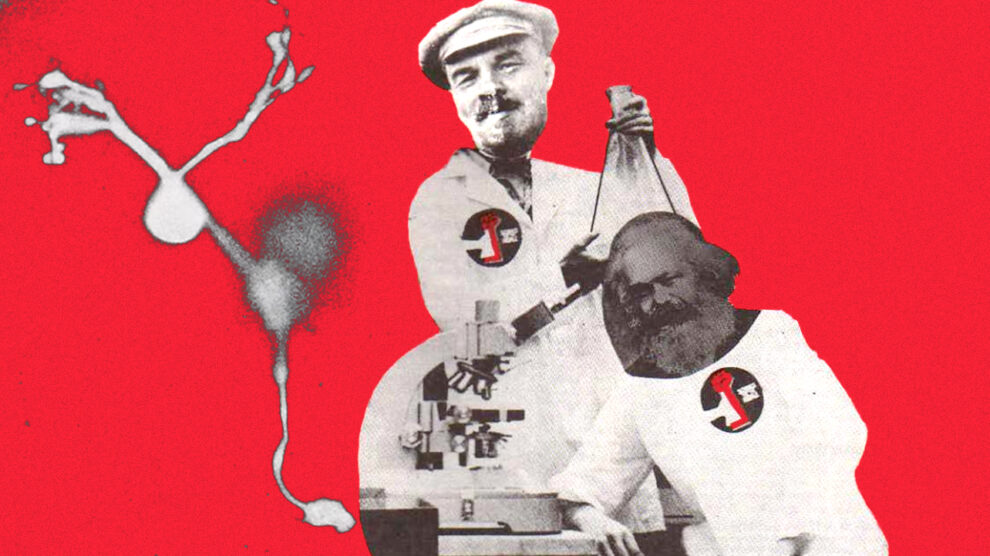

(Capital’s Prevention of) Proletarian Well-being
By James Brittain
Volume 27, no. 3, Public Health

Introduction
Once critically immersed in the living study of political economy, it took Marx little time to deduce that “the goal of the economic system is the unhappiness of society.”1 In no way suggesting that emotional duress is, or can be, exempt from the human experience, he cogently wed capitalism to despair. While provocative, this formulation calibrates how the latter is both exacerbated and normalized by the former. Neither can its association be viewed as natural, as said affects arrive through an engineered and necessitated class antagonism.2 With the vast majority of humanity, by design, divorced from that which is necessary for life, the many are compelled to shelve their self-directed, freely chosen, and preferred ways to create, make, and live it. To access some measure of subsistence, an inimical relation is fashioned where one class remains intact only through the appropriation and exploitation of another’s capacities. Even during periods of fiscal growth, Marx recognizes a “static misery” lies in wait to shock those who deliver and reproduce this labor-power for a capitalist society.3 Regardless of capital’s rate of return, the tendency of distress will unequally fall upon the working class.
While considerable time has passed since Marx fashioned this insight, current research suggests that as capital’s strength is consolidated the wellness of the proletariat pales in comparison.4 Countering assertions of societal prosperity, Clara E. Mattei posits that while the prevailing narrative is that business success will inevitably translate to success for everyone, what really occurs is the opposite: as profit and market gains rise, the worker’s well-being declines.5 Recent data from Canada grounds this critique, showing how the well-being of those who toil for a wage is anything but robust.6 A 2025 survey conducted by Statistics Canada, in association with the Minister of Industry, conveyed that over 43 percent of workers suffer from a constant state of stress while one-quarter have come to self-identify as workaholic.7 Compounding such angst, a separate report cited “money worries” to be the greatest source of anxiety for Canadians with roughly half reporting lost sleep due to financial strain.8 Looking at Gallup polling from 2024, 57 percent of workers in Canada were experiencing “daily stress,” 22 percent grappled with day-to-day bouts of sadness, and 17 percent disturbingly reported fits of rage-filled anger.9 Outcomes from 2025 fared even worse with increases in every one of these categories.10 When evaluating three consecutive decades of data, “impacts on mental health and well-being” have reached an all-time high for workers in this North American country.11
Like all things related to capital, such conditions are in no way isolated to a particular region. Even though mental health can be a forgotten terrain of disability, issues such as depression have become one of its foremost causes worldwide.12 Researchers, scholars, and workers have long sounded the alarm of rising transnational rates of distress. Since the 2010s, the World Health Organization (WHO) forewarned depression would be “the leading cause of disability by 2020” and unequivocally worsen in the decade to follow, which it has.13 Rather than respond, employers and states have shown little more than indifference.14
In the thick of this troubling reality, sense can be made in recalling that estrangement is indivisible from capital accumulation. As such, it is worth qualifying how disruptions to mental health intensify and show uneven effects for persons involved in wage-labor including those who rely on and/or reproduce it.15 The following, then, explores mental health by thinking through labor-power. Showing that much of the duress of proletarian life is a consequence of capital’s class formation, I map out three specific terrains. The first section faults apparent criticisms that evaluate wellness through selective social categories. Though valuable, analyses which decenter capitalist relations, cultivate distinct and separate diagnoses that clutter causality. The second section anchors how mental health is scarred through class and explores capital’s indifference to proletarian well-being and the disproportionate impacts levied upon those therein. In the third section I survey Marx’s configuration of labor-power. Here, mental and physical capabilities are recentered as essential for its realization. This brings to light more than simply an understanding of how well-being is impeded but elucidates the breadth of what and who is disaffected. Moving away from distress, the conclusion unearths optimism. As estrangement unequally denies working class wellness, so might it help sow solidarity which is needed to grow class struggle.
A Critique of Liberal Criticisms
Impairments to well-being are not unique to any place or period nor singular political-economic system. To frame mental health as a byproduct of capitalism is not to suggest that hurdles to mental health did not exist prior to its arrival.16 This mode of production does, nevertheless, entrench their habituation.17 In step with capitalism’s aggressive efforts to take off, systemic declines in mental health run adjacent with its ascendency—only now as an uncritically accepted constituent of liberal societies.18 Not a new prognosis, this tethering was perceptively attended to by Marx.
Within the detailed discussion related to the enclosures, there is a subtle inference in Part Eight of Capital Volume I regarding its holistic gravity. Nestled in chapter twenty-eight, Marx faintly calls attention to the “stress of circumstances” that coincide with capital’s original and ongoing accumulation.19 Pushed by the chaos of dispossession and displacement, a worker is formed and edged into a corner. With little room, a contoured class is compelled to rely on the sale of labor-power for a wage. The pain does not stop here. Dejected from the means to individually or collectively meet their needs, each worker’s ability to labor, and its choosing, become externalized resulting in a constant state of “self-sacrifice” that fosters a living “mortification.”20 Problematizing more than material conditions and outcomes, Marx expands the diameters of this “estrangement and indifference.”21 Of greater complexity than an isolated monetary system, he foregrounds the social relations under capitalism to be a modality of societal immiseration: a process where the proletariat “does not feel content but unhappy, does not develop freely his physical and mental energy but mortifies his body and ruins his mind.”22 Taking account of this economic subjection generated through the class relation, Marx indicts this exploitation as that which “lies at the bottom … of all social misery” and “mental degradation.”23 Often cited for ushering a pivotal evaluation of capital’s corporal and expansionary violence, Marx’s understated sentiments around stress in Volume I of Capital widen a critique of political economy and apprehend the inseparable mental and physical toll levied on a newly minted yet immediately tarnished working class. For this reason, liberal or social democratic analyses of mental health that undertheorize class (or wholly leave it out) can be critiqued for looking everywhere but capital’s social relations of production as the fulcrum to address said afflictions.
Scholarship evaluating social determinants of health has gained considerable traction in health studies. This work is widely available, well funded, soundly researched and, at times, even register scathing criticisms. Celebrated for its accessibility and transparent communication, the field articulates how health outcomes are better understood as knotted to a myriad of societal factors rather than simply one’s individual behavior or biology. This approach catalogues a growing number of influences that are used to explain how a person’s exposure to a variety of intersecting—yet segregated—categories correspond to their overall health and wellness. One of the most comprehensive and up-to-date reviews of said areas can be found in the WHO’s World Report on Social Determinants of Health Equity. This account provides a detailed report of key domains that include “Economic Systems,” “Social Infrastructure,” “Structural Discrimination,” “Conflict, Forced Migration, and Displacement,” and “Mega-trends: Climate Change and Digitalization.” Under each of these independent groupings are a series of designated subfields that rank, but are not limited to, themes such as class privilege and divisions in society, commercial determinants, financial systems, gender inequality, health emergencies, income inequality, industrial and trade policies, informal economy, labor markets, peace and health, racism, refugees and forced displacement, taxation systems, and finally universal social policies and public services adapted to urbanization and demographic transitions.24
As valuable as this existing survey is in reassessing how health is determined or deterred, there are problems. Beyond generating an ambiguity rather than clarity around detection or that its stratified list can induce confusion about what competing pressures should be prioritized first, a more disconcerting criticism is levied at what remains concealed and undetected. With the goal of ameliorating that which ails so much of society, class—and that which produces it—must be made clear. This does not suggest that work in the area of social determinants is empirically incorrect or without value. To the contrary, this work is rightly recognized for its broad analyses. The critique is centered on its variegation, which blurs a totalizing denominator and subsequently obscures any concrete prognosis for an alternative. In segregating signs and symptoms, change is inadvertently disparaged, obfuscating strategies to find a systemic remedy. With an overwhelming criterion and expanding diversification of particulars, its partitioned arithmetic displaces or excludes capitalism as the affixed thread weaving together all the above. Not a shared marker that stands beside an array of factors, capitalism is the terminal ailment that needs to be treated more crucially and given the attentive critical respect and political malice it deserves.25 This is essential to alter the ill effects being (re)produced and imposed upon an alienated and immiserated working class.
From a strategic standpoint, it is pertinent to critically evaluate social determinants of health—whether intentional or not—as accepting existing class relations and structures of capitalist power as ineradicable. When the class antagonism is taken as a given, this uninterrogated starting point shapes perspectives that naturalize capitalist social relations. Amid complying with its formation, analyses are left only to rely on capital’s ecosystem for answers. Any proposed solutions are, then, automatically foreclosed within the parameters of capitalism. Although surface aspersions may be cast, end goals are confined to (ironic) attempts to sway employers or those stationed within the capitalist state to, at best, take up social democratic reforms within their own existing hegemonic policies. Whether successful or not, such hopeful projects result in rehabilitating capitalist social reproduction rather than rectifying it. This calls for the field of study to also be critiqued ideologically. By its very framework of compartmentalizing social ills, this liberal methodology is incapable of anything other than palliative care. If triumphant in persuading those in power, those suffering remain feeling the same, albeit better informed about their depression. Lastly, the issue of tactics must also be scrutinized. Capitalism is a system first and foremost devoted to profit maximization. Research related to social determinants of health, which fails to center the social relations that hold up and reproduce capital’s inequitable drive for accumulation, cannot tactically foresee, let alone promote, anything outside this mode of production and, thus, left to plead for piecemeal assistance to a swelling yet shifting litany of ailments.
Analyses of health that excuse the basis for, and impact of, capitalist social relations generate misreadings. This is a prerequisite failure in detecting the prodrome that interrupts working class abilities. Even when theses appear to question capital’s influence, Toba Bryant, Scott Aquanno, and Dennis Raphael argue that “acceptance of capitalist-orientated policy approaches” do little more than enable, if not drive, a further normalization of a system that reproduces poor health (and inequality) under a rubric that codifies capital over the needs of people.26 Rather than being independent or separate manifestations, class analysis brings to the surface a deeper understanding of alienation that ties one’s quality of life to the appropriated exploitation of labor-power.27 While social determinants of health research and its continued study are necessary and commendable, a critical centering of its class character is vital to recognize the societal dimension that squares well-being.28
Capital’s Relation to Working Class Mental Health
In a system that compels humanity’s majority to sell their labor, there is a transhistorical pattern to be found between the growth of duress and the extraction of surplus value. Referring to this affective effect as “a great fact,” Marx measures that with capital’s expansion, the well-being of the proletariat declines.29 In the drafts that would make up Capital’s third volume, he writes that by its very nature, the capitalist mode of production is inattentive to “the labourer’s life … [and] health.”30 Continuing this motif, contemporary scholarship delineates how no “straightforward interest” leads a capitalist to meet or secure “a healthy laboring population,” for their existence is necessitated by the compulsion “to maximize profit in a competitive environment.”31 Both concealed and transparent, capitalism fosters an inherent incapacity to ensure any sense of wellness for those scraped of surplus value.
Capital’s harms, evaluates Marx, are not isolated to “blood and flesh” but mutually scar “nerve and brain.”32 When thinking through mental health, this proves incredibly helpful, as does the work of others. Michael A. Lebowitz, for example, rigorously elucidates how capital does not simply exploit but sustains a process that deforms the working class.33 He catches how one of its implicit characteristics is degrading “the mental … capacities of individual producers” while an entire owning class reaps.34 In concert with Lebowitz, Arnel M. Borras also sees capital’s driving force of accumulation as having absolutely nothing “to do with the needs of human beings,” much less their wellness.35 This coda is also heard in the work of Gargi Bhattacharyya who signals capitalism’s “indifference to human well-being” based on its reduction of working lives to “nothing more than adjuncts to the reproduction of capital.”36 All this is wholly in sync with Marx’s claim that in pocketing surplus value, the capitalist contributes to the “accumulation of misery.”37 While “reckless” toward proletarian health, capitalist conditions thrive as the cognitive well-being of the worker is cheapened.38 A class-based analysis of mental health, then, not only clarifies contemporary dynamics of power but furnishes greater insights toward society’s many ailments as structured by capital.39 By positioning class and its heterogenous complexities as, arguably, the most important determinant influencing mental health, a more complete assessment can be graphed.40
Most assuredly, persons on either pole of the class relation can experience challenges to wellness. To suggest otherwise would be sociologically erroneous and a contradiction to Marx’s own elaboration of alienation.41 As argued by Iain Ferguson, everyone’s mental health is harmed by capital’s pressures. Yet this does not mean “everyone is affected in the same way.”42 Understanding that disruptions to mental health cannot be siloed within a particular stratum, a rich appreciation of class analysis (and historical materialism) better informs how capital’s oppressive weight becomes inflamed and inordinately carried on the shoulders of those exploited.43 Hence, those who experience the greatest misfortune are, according to Marx, the masses who have “every atom” of their “bodily and intellectual activity” stolen for the profit and accumulation of a few.44 This register is crucial. As a system devoted to profit maximization, capitalism—and its beneficiaries—are entirely dependent on dilating the exploitation of alienated and commodified abilities and aptitudes.45 Correspondingly, the negative repercussions related to mental health are felt most by those with little choice but to sell this labor-power. Targeting the social relations behind this political economy offers a critically attentive and broadened explanation of why and how capitalism tempers the wellness of one class through the “materialist frameworks” owned by another.46
Capital’s mode of production, and the sociality it conjures, gives rise to a sense of alienation.47 Pairing the negation of self-directed labor-power with the hollowing out of well-being, Peter O’Grady is conscious that its effects are far more than material. He bridges that being a part of the proletariat predisposes those within it to an increased prevalence of problems related to mental health.48 According to O’Grady, the “loss of control over one’s capacity for creative and productive work” carries with it other consequences.49 Yes, the mislaying of a worker’s self-determination compromises their individual welfare, but it also spills over to dampen emotive and tangible connections with other human beings.50 Using the example of a household, conventional tropes may trace the origin of certain traumas to uncomfortable familial relations. The home, however, only tells one chapter of this story, let alone its preface. Chronicling mental health through class-based relations can better locate how stresses privately expressed under the family roof are introduced well before they arrive at its doorstep. Rather than solely attributing, say, impacts to a child’s well-being as isolated to a parent or guardian, they are seeded in the latter’s taxing relation to the means of production. Here, the effects of immiserating wage-labor, precarity, unemployment, or powerlessness are elucidated as being brought from the workplace into the home, where they are transferred and expressed through self-medication, domestic violence, suicide, or other transgressions.51
The layered consequences of wage-labor stretch past the immediate worker and impact the working class more broadly. This includes those who rely on its remuneration, replenish the labor-power to be sold each day, and enable its reproduction. As “daily activities, characteristics, propensities, foibles, creative works and thoughts” are shelved, if not completely abandoned, so are countless personal, private, and public aspects of proletarian life reduced.52 Fundamentally built upon alienation, what is being generated next to private profit is the “powerlessness and isolation” of the masses.53 When gauging the prosperity (or frailty) of humanity’s majority, Ferguson uses a particular vernacular and sums up that it is “the 99 percent” who paradoxically pay the innumerable prices for a system that fails them.54
Labor-Power’s Aggregation
Labor-power is precisely explained in Capital Volume I as “the aggregate of those mental and physical capabilities existing in a human being.”55 Though efforts on behalf of capital may attempt to generate a perception, if not logic, of a division between the two, David McNally observes that “the ostensible autonomy of [the] mind” is illusory.56 In both premise and performance, labor-power is only possible through their fused synapse.57 The work of Guglielmo Carchedi dutifully captures that the processes through which labor is realized “always exist conjointly” through a “mutual existential interdependence.”58 The execution of any work, regardless of whether it is abstractly earmarked as intellectual or manual, cannot be characterized in reality as separate.59 As labor-power houses the capacity to create, Carchedi politically and scientifically recognizes that “objective transformations require mental transformations, and vice versa.”60 This is what makes the “peculiar commodity” of labor-power so valuable when purchased and mobilized for the capitalist.61 Any interpretation that muscle works without, or in distinction to, the mind would be inattentive to both the theoretical and physiological reality of labor-power itself.
A considerate revisitation of labor-power and its makeup is important, especially when positioning mental health under capital. Amelia Horgan argues that one cannot “draw too sharp a line between mental and physical health,” as “the two are interwoven.”62 Contesting the propensity for “mental health discourses” to suggest otherwise, Micha Frazer-Carroll asserts that mind and body cannot be decapitated.63 So does O’Grady explain that “any satisfactory approach to mental health must acknowledge that people have physical bodies.” Like labor-power, to subdivide “‘health’ into physical and mental” categories would be an artificial breakup as “one always involves the other.”64 When referencing Marx’s efforts “to show that there are real bodies” behind the appropriated labor underpinning capital’s systems of oppression, McNally notes that it is actually existing “laboring bodies” that are repressed and become subjects of capitalist exploitation.65 By revisiting labor-power’s provision of mental and physical co-constituents, they are understood as mutually appropriated and concurrently damaged by and through capitalism. Often singularly read for the tax it levies upon the body, the toll of selling one’s labor-power always extends beyond tendons and tissue.
Evaluating mental health through the lens of labor-power provides a richer appreciation of its holistic estrangement. Not something compartmentalized, it is rather a site and state concurrently seen and unseen. Harms to mental health, which unequally trouble the working class, are deciphered not as individual (so-called) disorders, imbalances, or illnesses, but rethought as injuries heavily attributed to the exploitation of wage-labor with shared impacts on those who depend on and reproduce it. Centering capitalist social relations is important as it avoids political misdiagnosis. It detects the primary affliction interrupting working class abilities. Appreciating that the wear and tear on the proletariat is simultaneously corporeal and cognitive substantiates the breadth and diverse composition of the class being harmed. Exploring how Marx and fellow travellers attend to mental health and its impediment, stretches an understanding of the dis-abling social power of capital.66
Conclusion: The Revolutionary Potential for Well-Being to Enhance Class Struggle
Once sized, says Hannah Proctor, the affects and effects of today’s suffering are more than acute: they have become “axiomatic.”67 Instead of feeling defeated, however, the lived awareness of said maladies can empower the many made unwell. Conscientious that the vast majority of humanity comes to “sink” under the weight of capitalism, Marx (and Engels) hail how those from below have the faculty to rise up and marshal a localized, domestic, and global stare down.68 While duress and uncertainty weigh down workers, challenging its cause widens the ability to trade out despair for promise.
“Something shifts,” comments Bhattacharyya, when those within the proletariat come to recognize that their individual grief is not their own but part of an “interconnected heartbrokenness.”69 Bridging more than emotional awareness, such consciousness draws clarity to a system that thrives at its expense. As research related to mental health has shown the empirical benefits of non-hierarchical forms of sharing and engaging in collective dialogue as a successful method to ease anxiety, this is a pragmatic action to adopt and harness in working class geographies.70 Apart from opening processes that unburden workers’ immediate concerns, these lines of communication can additionally aid long-term connections for political mobilization. In magnifying everyday realities of exploitation, varied oppressions, and lived experiences brought on by capital, relations of solidarity and trust are nurtured. Here, organization takes the place of isolated alienation and moves the working class closer to fortifying possibilities to challenge capitalism’s ill effects.
Much like workers have shaped better conditions within the workplace, the proletariat can take their demands beyond it. As has been shown, the selling of labor-power impacts more than just the holder of the living labor sold. The corrosion and fatigue of wage-labor transcends the location of its sale and touches the many lives connected to it. In recognition of this, the working class must ensure its lines of communication and organization cross both circuits of production and reproduction, as they are mutually affected. Though differing feelings may be present, hopelessness need not be one. Showing that a correlation exists between muted expressions of class struggle and unhealthy levels of well-being, Ferguson posits that “the confidence and sense of collective agency that comes from fighting back can only be good for mental health.”71
This does not suggest mental health impairment is epiphenomenal. In no way would the pains of humanity somehow disappear if the dustbin of history were to be filled with what needs to be thrown out. Cancer diagnoses will still be gently delivered. The sadness of a breakup will continue to fracture hearts. People will not stop mourning the passing of those they love. While sobering, distress, heartache, and sorrow will all be present upon the sundown of capitalism much like they will continue on the first day of whatever follows.72 This is not to say, however, that collectively shaping a new set of social relations, prefaced first and foremost by meeting people’s needs, would not better comfort or reduce this melancholy. What is assured is that as long as the current system remains intact, it will reproduce nothing more than a fantasy of a flourishing and healthy working class.73
In moving beyond isolated anxieties, solace can be found even when surrounded by turmoil. To paraphrase Bhattacharyya: it is worth reflecting on the fact that before the joyful celebration of any cultivated revolution, there were many tears spilled that helped water its victory.74 Registering that unhappiness is inflamed by capital can assist those who sell their labor-power, and those involved in its reproduction, in seeing beyond individual barriers to mental health so the many can begin organizing to confront the systemic barrier impeding the well-being of all people and the planet.
—
James J. Brittain is a Professor of Sociology at Acadia University and steering committee member of the Marxism & Disability Network. As capitalist social relations impede the flourishing of all, Brittain’s work appreciates those who sell and replenish the labour-power upon which capitalism is so fundamentally dependent yet equally dismisses. Much can be learnt from this holistic working class and their potential to prioritize the needs of humanity and the non-human world over private accumulation and profit. @jim.brittain
Notes
- Karl Marx, “Economic and Philosophic Manuscripts of 1844,” in Karl Marx and Frederick Engels Collected Works: Volume 3 – Marx and Engels March 1843-August 1844 (International Publishers, 1975), 239 [italics in original].
- Not defined by an aesthetic or identity, completed level of education, location in a given society, or income level, class is clearly understood as a particular social relation to the mode of production (see Ellen Meiksins Wood, The Origin of Capitalism: A longer view (Verso, 2017); Democracy Against Capitalism: Renewing Historical Materialism (Verso, 2016); The Retreat from Class: A New ‘True’ Socialism (Verso, 2006)).
- Marx, “Economic and Philosophic Manuscripts of 1844,” 239, 241 [italics in original]; see also Karl Marx, “Capital, A Critique of Political Economy: Volume I,” in Karl Marx and Frederick Engels Collected Works: Volume 35 – Marx – Capital Volume I (International Publishers, 1996), 609.
- This explains how some can exist inside “one of the richest societies in history,” yet live “in near-Dickensian levels of hardship”
- Clara E. Mattei, Escape from Capitalism: An Intervention (Simon & Schuster, 2026), 9.
- Even though “mental health concerns touch all segments of Canadian society,” it is workers who are most widely impacted (Grant Larson, “Mental Health Disability: The Forgotten Terrain,” in Disability and Social Change: A Progressive Canadian Approach. Edited by Jeanette Roberston and Grant Larsen. (Fernwood Publishing, 2016), 188).
- Statistics Canada, Pressed for Time (Government of Canada, 2025), 1. Voicing concerns about the lack of space outside the workplace for social interaction, just under half of those surveyed conveyed “not spending enough time with family or friends.” Regardless of how one identified via binary and nonbinary categories, men+ [28.7 percent] and women+ [25.3 percent] perceived their lives as dominated by waged labor. In another Statistics Canada study, it was noted that the “likelihood” of “working-age Canadians” Statistics Canada, Pressed for Time (Government of Canada, 2025), 1. Voicing concerns about the lack of space outside the workplace for social interaction, just under half of those surveyed conveyed “not spending enough time with family or friends.” Regardless of how one identified via binary and nonbinary categories, men+ [28.7 percent] and women+ [25.3 percent] perceived their lives as dominated by waged labor. In another Statistics Canada study, it was noted that the “likelihood” of “working-age Canadians” to simply see “a friend on an average day” has declined decade over decade (Statistics Canada, Time Pressure and Time Spent with Friends over the Last 30 years (Government of Canada, 2025), 3).
- Government of Canada, “Financial Stress and Its Impacts,” April 1, 2025, https://www.canada.ca/en/financial-consumer-agency/services/financial-wellness-work/stress-impacts.html#fn2; see also Statistics Canada, “Annual wages, salaries and commissions of T1 tax filers, 2022,” April 12, 2024, https://www150.statcan.gc.ca/n1/daily-quotidien/240412/dq240412a-eng.htm. Accounts of work-induced insomnia need not be quarantined to Canada. From the other side of the Atlantic, see the work of Micha Frazer-Carroll, Mad World: The Politics of Mental Health, (Pluto Press, 2023), 80.
- Gallup, State of the Global Workplace: The Voice of the World’s Employees – 2024 Report (Gallup Inc., 2024), 103-104.
- Daily stress rates rose to 58 percent, sadness to 23 percent, and anger to 19 percent (Gallup, State of the Global Workplace: Understanding Employees, Informing Leaders – 2025 Report (Gallup Inc., 2025), 94-95). The 2025 report, however, added a new category related to daily loneliness with 16 percent of respondents claiming this as an issue of concern. The most recent data from 2026 shows no sign of relief, as percentages remained the same for stress and sadness while anger [20 percent] and loneliness [17 percent] saw increases (Gallup, State of the Global Workplace: The Human Side of the AI Revolution – 2026 Report (Gallup Inc., 2026), 87). From a regional context, Canada alongside the United States leapt from holding the second highest rates of workplace stress in the world during 2024 to first in both 2025 and 2026 (Gallup, State of the Global Workplace – 2025, 18, 24; Gallup, State of the Global Workplace – 2024, 27, 33; Gallup, State of the Global Workplace – 2026, 20).
- For comparison, rates in the early 1990s were “about one in seven (15.0%)” whereas the 2000s saw roughly one in five (Statistics Canada, Time Pressure and Time Spent with Friends over the Last 30 years, 1; Larson, “Mental Health Disability,” 188). It should not go unacknowledged that such data is derived from a country with universal healthcare, as Canada ensures primary services and supports are accessible and available to all eligible residents through a publicly funded system. Far from claiming this to be an ideal expression of socialized medicine, this should be taken into consideration (see Beatrice Adler-Bolton and Artie Vierkant, Health Communism (Verso, 2022), xiv). If mental health issues are of concern in countries such as Canada, where supports are to some degree covered by the state, even greater scrutiny is warranted toward a system, like that within the United States, where healthcare is rooted in a model that promotes privately financed coverage through the market.
- World Health Organization, Comprehensive Mental Health Action Plan 2013–2030 (WHO, 2021), 3; see also Larson, “Mental Health Disability.” Rather than perceiving hurdles to ability as narrowly defined by only those in need of “mobility aids, full-time care, and physical, permanent barriers to leaving bed or the house,” it is vital to appreciate that “at least 70% of disability is considered to be ‘invisible.’” (Frazer-Carroll, Mad World, 90-91; see also Lennard J. Davis, Enforcing Normalcy: Disability, Deafness, and the Body (Verso, 2025), xiii, 1-2).
- Graham Scambler, “Heaping Blame and Shame: ‘Weaponising Stigma’ for Neoliberal Times,” The Sociological Review Monographs 66, no. 4 (2018): 775; Would Health Organization, Global Burden on Mental Health and the Need for Comprehensive, Coordinated Response from Health and Social Sectors at the Country Level – Secretariat Report (WHO, 2011), 1; see also Roddy Slorach, A Very Capitalist Condition: A History of Politics and Disability, Second Edition (Bookmarks, 2024), 271, 28.
- Documenting this dismissal, the WHO outed various state-based institutions for retracting efforts to address the widening prevalence of mental health needs. Their findings recorded rollbacks or withdrawals in research and actions to better understand national and global declines in well-being (World Health Organization, Mental Health Atlas 2024 (WHO, 2025). Regrettably, this all but reaffirms that “of all areas of disability, mental health arouses the greatest fear, ignorance and discrimination.” (Slorach, A Very Capitalist Condition, 28).
- Peadar O’Grady, “Stop Making Sense: Alienation and Mental Health,” Irish Marxist Review 3, no. 11 (2014): 47. Far more inclusive than certain narrow interpretations, I follow Susan Ferguson and David McNally’s acute composition of the working class as being “all those dispossessed of means of producing for themselves and thus reliant for their subsistence and reproduction on the market.” Hence, what it means to be “a proletarian” encompasses a more comprehensive category cognizant of the current social relations of (re)production under capitalism, which are of greater complexity than simply being “a wage-labourer.” (Susan Ferguson and David McNally, “Precarious Migrants: Gender, Race and the Social Reproduction of a Global Working Class,” in Socialist Register: Transforming Classes (Fernwood, 2015), 21n.30; see also Alan Sears, The Next New Left: A History of the Future (Fernwood Publishers, 2014), 4, 22, 111).
- Iain Ferguson, Politics of the Mind: Marxism & Mental Distress (Bookmarks, 2023), 29; see also Joyce Chedia et al., Disability and Empire: Class, U.S. Imperialism, and the Struggle for Disability Justice (1804 Books, 2024), 1-2; Slorach, A Very Capitalist Condition, Chapters 4-6.
- Recognizing capitalist society as distinctive, James Davies surveys that the rise in mental health issues “did not emerge in a vacuum.” Particularly since the 1980s, and regardless of country assessed, a quantitative and qualitative correlation is found between efforts to stabilize capital accumulation and a lack in wellness (James Davies, Sedated: How Modern Capitalism Created our Mental Health Crisis (Atlantic Books, 2022), 4, 47).
- With reference to Europe, impairments habitually followed the solidification (and struggles) of class antagonism from the nineteenth century onward. While scholars such as Sasha Warren speak to the influence of the Industrial and French Revolutions on mental health, Hannah Proctor provides a brilliant, albeit disturbing, account of how affective harms were purposefully induced on workers from the onset and outcome of the Paris Commune (Sasha Warren, Storming Bedlam: Madness, Utopia, and Revolt (Common Notions, 2024), 13; Hannah Proctor, Burnout: The Emotional Experience of Political Defeat (Verso, 2024), 49-51).
- Marx, “Capital, Volume I,” 723.
- Marx, “Capital, Volume I,” 724. Befitting of such language, McNally frames how efforts of “separating, dissecting, and alienating” the labor-power of workers is taken up to not only contribute to the health of one class but in an attempt to mystify the shared reality of another’s exploited and penurious conditions (David McNally, Monsters of the Market: Zombies, Vampires and Global Capitalism (Haymarket, 2011), 123, 124).
- Karl Marx, “Capital: A Critique of Political Economy, Volume III,” in Karl Marx and Frederick Engels Collected Works: Volume 37 – Marx – Capital Volume III (International Publishers, 1998), 89.
- Marx, “Capital, Volume I,” 724.
- Karl Marx, “Provisional Rules of the Association,” in Karl Marx and Frederick Engels Collected Works: Volume 20 – Marx and Engels 1864-68 (International Publishers, 1985), 14; Karl Marx, “Rules and Administrative Regulations of the International Working Men’s Association,” in Karl Marx and Frederick Engels Collected Works: Volume 20 – Marx and Engels 1864-68 (International Publishers, 1985), 441.
- World Health Organization, World Report on Social Determinants of Health Equity (WHO, 2025), xiii.
- Through their intervention “into the lineage of scholarship on what are called the social determinants of health,” Beatrice Adler-Bolton and Artie Vierkant are clear in prefacing “capital” as the “central social determinant” (Health Communism, xv, 4). Arnel M. Borras also speaks to capital’s relation to profit maximization (and state compliance) as making health and wellness implausible under its regime (Arnel M. Borras, Health and Healthcare Inequalities: A Critical Political Economy Perspective (Fernwood Publishing, 2025), 117, 122-123, 134).
- Toba Bryant, Scott Aquanno, and Dennis Raphael, “Impact of Covid and Canadian Welfare State Policies,” in Oppression: A Social Determinant of Health, Second Edition. Edited by Elizabeth A. McGibbon. (Fernwood Publishing, 2021), 266.
- See Carles Muntaner and Rob Wallace, “Confronting the Social and Environmental Determinants of Health,” in Health Care Under the Knife: Moving Beyond Capitalism for Our Health. Edited by Howard Waitzkin. (Monthly Review Press, 2018), 225; Gordon D. Schiff and Sarah Winch, “The Degradation of Medical Labor and the Meaning of Quality in Health Care,” in Health Care Under the Knife: Moving Beyond Capitalism for Our Health. Edited by Howard Waitzkin. (Monthly Review Press, 2018), 46.
- Raju J. Das, “Understanding Marx on Health: Toward a Class-based Approach,” in The Routledge Handbook on the Political Economy of Health and Healthcare. Edited by Rodney Loeppky and David Primrose. (Routledge, 2024), 47.
- Karl Marx, “Inaugural Address of the Working Men’s International Association,” in Karl Marx and Frederick Engels Collected Works: Volume 20 – Marx and Engels 1864-68 (International Publishers, 1985), 5.
- Marx, “Capital, Volume III,” 89-90.
- Alan Sears, Eros and Alienation: Capitalism and the Making of Gendered Sexualities (Pluto Press, 2025), 25.
- Marx, “Capital, Volume III,” 92.
- Michael A. Lebowitz, “Know Your Enemy: How to Defeat Capitalism,” June 10, 2021, https://links.org.au/know-your-enemy-how-defeat-capitalism; Michael A. Lebowitz, Between Capitalism and Community (Monthly Review Press, 2020), 8, 79; Michael A. Lebowitz, The Socialist Imperative: From Gotha to Now (Monthly Review Press, 2015), 21, 174; Michael A. Lebowitz, The Contradictions of ’Real Socialism’: The Conductor and the Conducted (Monthly Review Press, 2012), 14; Michael A. Lebowitz, The Socialist Alternative: Real Human Development (Monthly Review Press, 2010), 16.
- Lebowitz, The Socialist Imperative, 22.
- Michael A. Lebowitz, “What Keeps Capitalism Going?” Monthly Review 56, no. 2 (2004): 20; Borras, Health and Healthcare Inequalities, 86.
- Gargi Bhattacharyya, The Futures of Racial Capitalism (Polity Press, 2024), 145; see also Todd Gordon, “Why the Boss Is Happy to Let You Die: Capitalism and the Struggle for Life,” December 28, 2020, https://spectrejournal.com/why-the-boss-is-happy-to-let-you-die/.
- Marx, “Capital, Volume I,” 640.
- Marx, “Capital, Volume I,” 275-276.
- Muntaner and Wallace, “Confronting the Social and Environmental Determinants of Health,” 226; see also Raju J. Das, “Capital, Capitalism and Health,” Critical Sociology 49, no. 3 (2023), 407; Nafis Hasan, Metastasis: The Rise of the Cancer-Industrial Complex and the Horizons of Care (Common Notions, 2025); Rupa Marya and Raj Patel, Inflamed: Deep Medicine and the Anatomy of Injustice (Farrar, Straus and Giroux, 2021), 13.
- David Matthews, “Mental Illness and Capitalism,” September 14, 2023, https://spectrejournal.com/mental-illness-and-capitalism/; see also David Matthews, “Capitalism and Mental Health,” Monthly Review 70, no. 8 (2019): 49-62.
- Karl Marx and Frederick Engels, “The Holy Family or Critique of Critical Criticism: Against Bruno Bauer and Company,” in Karl Marx and Frederick Engels Collected Works: Volume 4 – Marx and Engels 1844-45 (International Publishers, 1975), 36; Marx, “Economic and Philosophic Manuscripts of 1844,” 282; see also Vanessa Christina Wills, Marx’s Ethical Vision (Oxford University Press), 54.
- Feguson, Politics of the Mind, 30; see also Iain Ferguson, “Marxism and Mental Distress: A Reply to Shirley Franklin,” January 2, 2019, https://isj.org.uk/marxism-and-mental-distress-a-reply-to-shirley-franklin/#footnote-10080-3-backlink; see also Matthews, “Mental Illness and Capitalism”; Danny Dorling, Inequality and the 1% (Verso, 2019), 131.
- For an expansive analysis of a broadly inclusive “reconstructed” historical materialist approach see the work of David Camfield, Red Flags: A Reckoning with Communism for the Future of the Left (Fernwood Publishing, 2025), 10-13, 136; We Can Do Better: Ideas for Changing Society (Fernwood Publishing, 2017); 48, 51, 104, 108, 110; “Theoretical Foundations of an Anti-racist Queer Feminist Historical Materialism,” Critical Sociology 42, no. 2 (2016): 289-306.
- Marx, “Capital, Volume I,” 425-426.
- Capitalism as a system, is apathetic toward working class mental health. Not accidental or by coincidence, various scholars have identified how this is by design (Frazer-Carroll, Mad World, 70; see also Ron Roberts, Psychology and Capitalism: The Manipulation of Mind (Zero Books, 2015), 50; Ferguson, “Marxism and Mental Distress”).
- Emil Øversveen and Conor A. Kelly, “Alienation: A Useful Concept for Health Inequality Research,” Scandinavian Journal of Public Health 50, no. 7 (2022), 1019.
- Øversveen and Kelly, “Alienation,” 1019.
- O’Grady, “Stop Making Sense,” 40.
- O’Grady, “Stop Making Sense,” 43.
- O’Grady, “Stop Making Sense,” 43.
- O’Grady, “Stop Making Sense,” 40, 42-43. This mirrors what Frazer-Carroll has to say: “the mental burden of work is not limited to a person’s shift, and does not end when we clock out” (Frazer-Carroll, Mad World, 80).
- Roberts, Psychology and Capitalism, 38.
- Ferguson, Politics of the Mind, 16; see also Øversveen and Kelly, “Alienation,” 1019; see also Borras, Health and Health Care Inequalities, 83.
- Ferguson, Politics of the Mind, 27.
- Marx, “Capital, Volume I,” 177; see also 368; Marx, “Economic and Philosophic Manuscripts of 1844,” 276; Karl Marx and Frederick Engels, “The German Ideology: Critique of Modern German Philosophy According to Its Representatives Feuerbach, B. Bauer and Stirner, and German Socialism According to Its Various Prophets,” in Karl Marx and Frederick Engels Collected Works: Volume 5 – Marx and Engels 1845-47 (International Publishers, 1976); see also Karl Marx, “Theses on Feuerbach,” in Karl Marx and Frederick Engels Collected Works: Volume 5 – Marx and Engels 1845-47 (International Publishers, 1976), 4. It is, however, important to note that scholars have suggested during the earlier period Marx had not fully formalized a “distinction between labour and labour-power” (Peter Hudis, Marx’s Concept of the Alternative to Capitalism (Haymarket, 2012), 60n.117).
- David McNally, Blood and Money: War, Slavery, Finance, and Empire (Haymarket, 2020), 60; see also Raju J. Das, Marxist Class Theory for a Skeptical World (Brill, 2017), 124, 299.
- As “capitalists need to purchase labor power, the human capacity to work,” which compels one class to “submit to the temporary alienation of their capacities,” a process that cannot separate “the intentional human beings (mind and body)” regardless of its method is enshrined (Sears, Eros and Alienation, 25).
- Guglielmo Carchedi, Frontiers in Political Economy (Verso, 1991), 22.
- Guglielmo Carchedi, “The Crisis and Marx’s Theory of Knowledge,” in Returns to Marxism: Marxist Theory in a Time of Crisis. Edited by Sara R. Farris. (Haymarket, 2016), 19; see also 21-22.
- Carchedi, “The Crisis and Marx’s Theory of Knowledge,” 21, 22.
- Marx, “Capital, Volume I,” 180, 203.
- Amelia Horgan, Lost in Work: Escaping Capitalism (Pluto Press, 2021), 69.
- Frazer-Carroll, Mad World, 8-9. Contesting this false decapitation, they compound bodymind.
- O’Grady, “Stop Making Sense,” 39.
- David McNally, Bodies of Meaning: Studies in Language, Labour, and Liberation (State University of New York Press, 2001), 66, 75.
- See Aaron Jaffe, “Social Reproduction Theory and Disability: Overcoming the Reified Form of Labor Powers,” February 19, 2024, https://spectrejournal.com/social-reproduction-theory-and-disability/; Social Reproduction Theory and the Socialist Horizon: Work, Power and Political Strategy (Pluto Press, 2020), 46-57).
- Proctor, Burnout, 28.
- Karl Marx and Frederick Engels, “Manifesto of the Communist Party,” in Karl Marx and Frederick Engels Collected Works: Volume 6 – 1845-48 (International Publishers, 1976), 491, 485; see also 487, 494.
- Gargi Bhattacharyya, We, the Heartbroken (Hajar Press, 2024), 80.
- Ferguson, Politics of the Mind, 18, 61; Slorach, A Very Capitalist Condition, 200.
- Ferguson, Politics of the Mind, 139, 22.
- Terry Eagleton, Why Marx Was Right (Yale University Press, 2011), 65; Ferguson, Politics of the Mind, 29.
- Adler-Bolton and Vierkant, Health Communism, xi.
- Bhattacharyya, We, the Heartbroken, 8, 115.