
Letter from the Editors
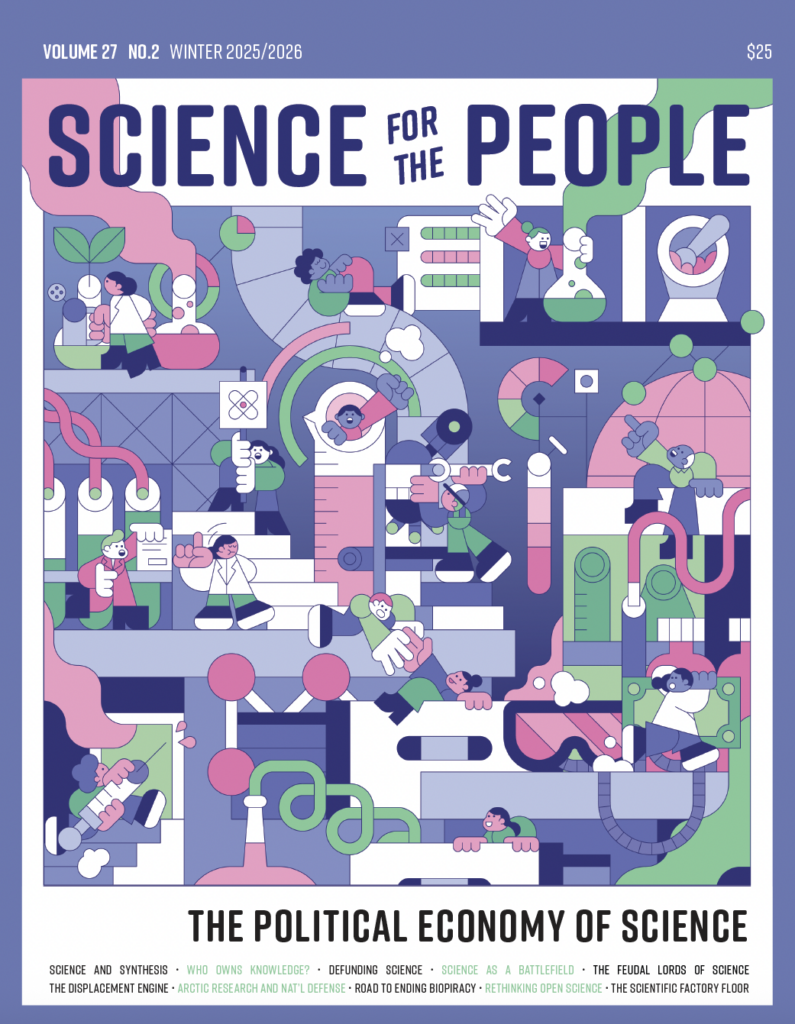
Volume 27, no. 2, Political Economy of Science
At an early stage in any scientist’s education, we are faced with a question that will follow us for the rest of our careers with every project we pursue, every paper we publish, and every grant we seek. At some point we will be asked, “What are the implications of this research?” The answer is often coached by our mentors because we are imbricated in an already-existing research program (for example, “I am developing more sensitive detectors that will be useful in dark matter experiments”), which may be justified by potential improvements in social benefit (such as, “If successful, this research will lead to an effective treatment for breast cancer!”). Rarely in our careers are we asked to follow this chain of logic through, to question why or how we are paid to do the things we do or who is paying us to do them. In this issue, we provide some examples of where such a radical questioning could lead.
Political economy is a way of studying societies through the entanglement of politics and economics, investigating how power and resources inform economics and shape the relationships between people and institutions. Science is an integral part of economic production, so it is crucial that we investigate the social function of science through a political economic perspective. Science, contrary to the popular misconception of its purity and neutrality, serves an important function in the development and maintenance of political and economic power under capitalism. For this reason, major actors (industry, states, and militaries) are incentivized to dictate science’s agenda, capture scientific products, and use scientists to mold the world and increase their profits.
Science’s utility for capital takes on several independent forms. First, and most importantly in the context of political economy, scientific progress leads to immediate improvements in worker productivity, and as a result increased profits and a competitive edge for those capitalists who can maintain exclusive control over their productivity. Second, research and development of specific technologies facilitate the direct domination of local populations through the emergence of new weapons systems and techniques of surveillance. Finally, science provides significant ideological cover for domination in the cultural sphere through the promise of technocratic solutions to social problems. Policymakers equipped with scientific jargon gain credence by justifying any policy with ideologically neutral language, a powerful tool for undermining critique and resistance and for maintaining social control.
As a result, scientific practice today is deeply intertwined with mechanisms of exploitation and domination. In this issue we explore several of these points of contact. Batool Almarzouq examines how scientists give systems of domination legitimacy through a dependency-theory critique of Open Science in a post-colonial world. Eric Brown details the use of scientific exploration to exploit fragile ecosystems, drawing on the complicity of the University of Maine’s Climate Change Institute in the warmongering geopolitics of a melting Arctic. Mamoru Erina provides a historical analysis of the Okinawa Institute of Science and Technology’s origins, which are tied to Japanese neo-colonialism and US militarization of the region, and discusses how this prestigious institution exploits the Indigenous Ryukyu communities under the guise of scientific progress and economic development. Courtney Addison and Max Soar provide an analysis of New Zealand’s rightward political shift and epistemic destruction of science and higher education, demonstrating the global scale in the ongoing commodification of knowledge toward extractivism and militarism.
Philosopher Helena Sheehan calls on scientists and radical scholars to employ a Marxist philosophy of science based on the understanding of capitalism’s totality, which is answered by articles from Alice Malone and Diego Kozlowski, Natsumi S. Shokida, and Carolina Pradier, whose article poses fundamental questions about the structure of scientific knowledge production through a Marxist lens. This issue also includes a piece by Melas Ibirgh about rent extraction by the industrial publishing oligopoly and a reflection from Renu Kumari on the process of alienation of research labor. In addition, Nuzrath Jahan and Renato Flores review The Eye of the Master: A Social History of Artificial Intelligence and Knowledge as Commons: Toward Inclusive Science and Technology, presenting their syntheses on the political economy of AI and science-based social movements, respectively.
As scientists, we are committed to searching for and refining human knowledge about nature. In this commitment, we must observe that the forces guiding research priorities are rarely interested in human welfare or an enlightened search for truth. We must not only reject the use of our work toward the further exploitation of the world’s peoples (ourselves included), but we must also organize to overthrow this system of perverse incentives altogether. We hope this issue will spur others to think of their work in such a context, to question this context, and to join us in dismantling it.
—Volume 27, no. 2 editorial collective